The most expensive email in Zakynthos
This is an English translation of the original Greek article. Quotations are our translation; most linked sources are in Greek.
€871,907 to be repaid, 34 years without mains water in Loucha and Giri, and a Municipal Authority that, about the next project at risk, talks of “an email that was forgotten”. Who will pay? We will.
At a glance
- €871,907.37 is what the EU programme’s Managing Authority is asking the Municipality of Zakynthos to repay for the mountain-villages water pipeline (final report, in Greek).
- The project has been 98.1% paid. Mains water in Loucha and Giri: not yet.
- For the next project at risk, the Mayor said someone “forgot to send an email”.
- The Municipality is going to court. The repayment and the lawyers will ultimately be paid by residents.
- We ask for: publication of all the documents, names on every signature, a timetable for the water.
The final report of the Managing Authority on the Agia Marina – Loucha – Giri – Agios Leontas water pipeline is now public. The Municipality of Zakynthos is named as liable to repay €871,907.37: €807,254.91 for expenditure that could not be verified, plus a €64,652.46 correction for everything else (pp. 56–58). Loucha and Giri still have no mains water.
Within 48 hours the Mayor, the chair of the water utility DEYAZ, a Deputy Mayor and the MP for Zakynthos all spoke. There is little we need to add. It is enough to listen to them, and to remember what they said before.
The Citizens of Zakynthos look at public works the way an engineer or an auditor would: contracts, certifications, deadlines and numbers. From that standpoint we find it unacceptable to hear, in public debate, that the fate of an EU-funded project, the Filikon Street pipeline, came down to “an email”. Public works are not lost because “an email was forgotten”. They are lost because an administration never built a system to make sure deadlines are not forgotten. And when a Municipal Authority publicly treats such an omission as trivial, it does not just play down the mistake. It plays down its responsibility to every resident who will be asked to pay for it.
What the front pages say
It is not only us saying it. The case made the front page of both of the island’s daily newspapers.
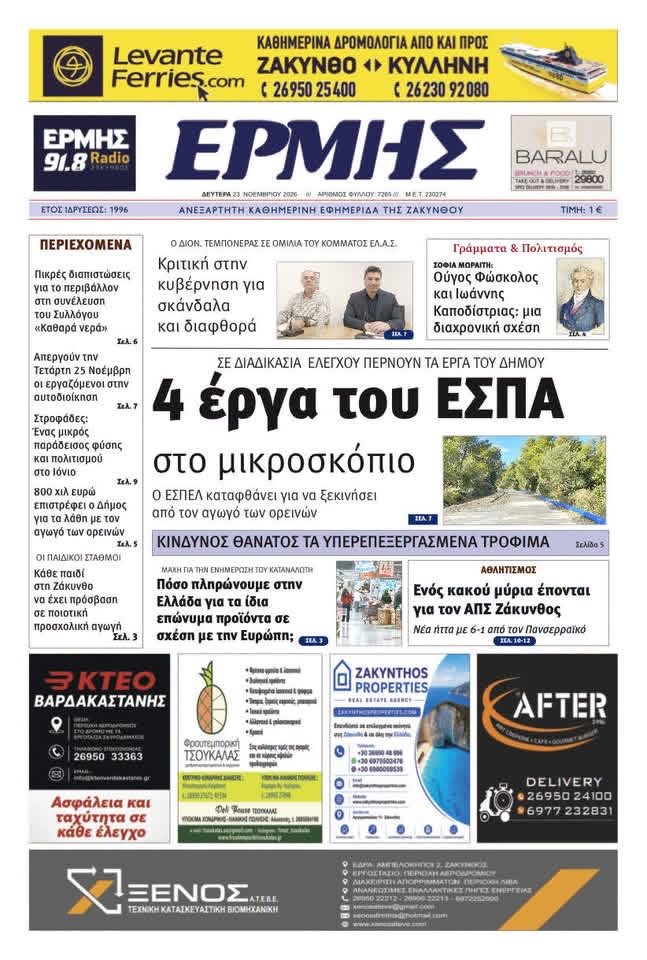
Ermis, Monday 23/11/2026: “4 EU-funded projects under the microscope – Quality inspectors arrive, starting with the mountain-villages pipeline” and “€800,000 to be repaid by the Municipality for the mistakes on the mountain pipeline”.
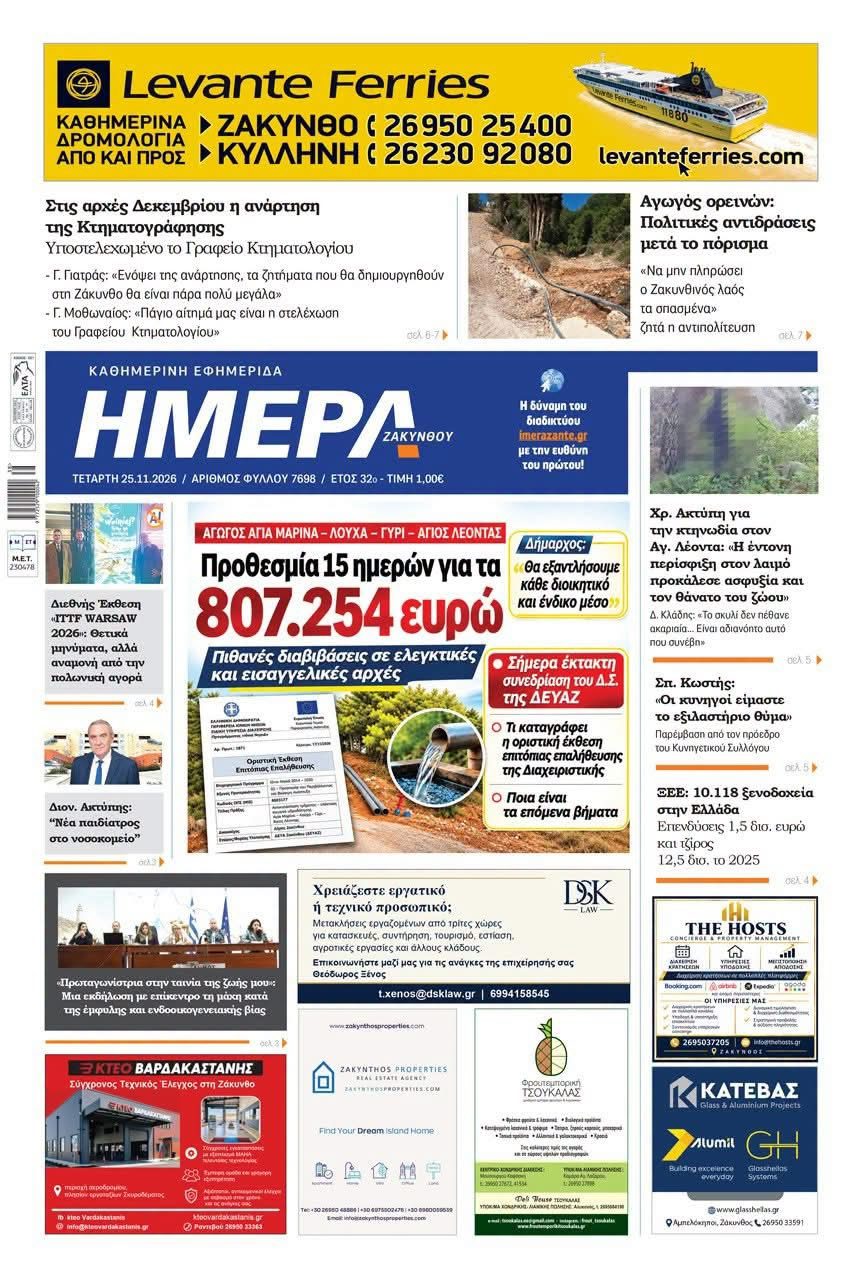
Imera, Wednesday 25/11/2026: “15-day deadline for the €807,254 – Possible referrals to audit and prosecuting authorities”. Next to it, the Mayor: “We will exhaust every administrative and legal remedy”.
Four municipal projects under quality inspection, one already with a final repayment report, possible referrals to prosecutors. And the Municipal Authority’s first reaction is not “we will check what happened”. It is “we will go to court”.
What they told us before
Let us start at the beginning. At the first session of the new Municipal Council, on 2 January 2024, with the MP for Zakynthos present, the Mayor set the rules of his term:
We kept the record, as he asked. Almost three years later, the “compass” points elsewhere: - “Fast and effective”: an extension request that, by his own account, was “forgotten”. - “Full information of the municipal council”: three postponements of the briefing on the report. - “Transparency in the management of resources”: a final report worth €871,907 that was published by the newspaper Imera, not by the Municipality.
In September, when the opposition asked whether work had been paid for that was never done, the Mayor answered confidently that the audit would decide: “And I am glad they ask such questions, because they will get the corresponding answers”. About the opposition he added: “their goal is for the mountain villages never to get water”.
At the same time the President of the Municipal Council asked: “If it is proven that everything was in order and the payments were made properly, then who, I wonder, will apologise?”
The answers came. The audit decided. And now the question runs the other way: who will apologise now that it has been shown the payments were not made properly?
In October, with the provisional report in hand, the Mayor described the findings as provisional, not final and reassured us: “Whatever the cost, we are obliged to complete the project. Even if the contractor is declared in default […] we will contribute our own money”. In November, with the final report: “The Municipality has no money of its own, nor does it pay from its own resources”.
The chair of DEYAZ was even calmer. The findings were “some of them serious, others of minor importance”, and “at any other time, these audit observations would have been answered by the services without drawing attention”. Those who were worried were having “coffee-shop discussions, which is their right”. And himself: “I worry about everything, but I have nothing to fear”.
A month later, the findings “of minor importance” cost €871,907. The “coffee shop” turned out to be right. And he now speaks of “a negative development” and of “an issue of a political nature too”.
On briefing the Municipal Council, the Mayor promised on 14/10 to do it within 15 days, on 4/11 next week on 24/11 at the next Municipal Council and on 25/11 again next week (in Greek). Not even a briefing keeps to its deadline. No wonder emails get forgotten too.
“Someone forgot to send an email”
The “email” the Mayor spoke about mainly concerns the second pipeline, on Filikon Street, which is heading for the same bill. The Mayor, on IonianRadio:
Yes, Mr Mayor, it can. On a multi-million project, the deadline is the simplest thing a municipality has to keep track of: a calendar, a reminder, an email. He himself asks whether it is possible to charge “the people of Zakynthos 800,000 or 1 million euros because some employee, being human, forgot to make an extension request”.
Then Zakynthos has just acquired the most expensive email in its history. And the question is not which employee forgot it. It is who runs a municipality where millions depend on one employee’s memory.
The Mayor has an answer for that too:
In other words, the Municipal Authority expects the Managing Authority to remind it of its own deadlines. The audited asks the auditor to do its job for it.
It is not only Filikon. It is a habit.
The “forgotten email” on Filikon is not an isolated accident. According to the report of his interview on Stigma radio (in Greek), the Mayor himself said a similar issue had arisen on Loucha–Giri too. The final report on the mountain pipeline, a different project, records, among other things: - a late extension request; - two years (2024 and 2025) without the required progress reports; - no project log, and no penalty on the contractor for the delays; - the project was “closed” and paid for on paper without being finished in reality.
These are the simplest duties of any body that manages public money: send documents on time, keep a log, enforce penalties, do not pay for what was not done. By their own admissions, the Municipal Authority and DEYAZ show that they cannot manage even these.
And for anyone who thinks we exaggerate: four days after the final report arrived, the Deputy Mayor for Cleanliness said:
“First of all, I haven’t received the report, I haven’t read it and I don’t know it.”
The same day the chair of DEYAZ said that “today there was a full briefing” of the members of the Municipal Authority. A report demanding €871,907 from the Municipality, and a member of the Municipal Authority has not read it. So it is not only deadlines that are missed. It is also reports that go unread.
“Whatever we did, we did with approvals”
On who is to blame, the Mayor has a ready answer: everyone else.
“Whatever we did, we did with the approval of the Managing Authority.”
“It cannot blame us for a project that has been running since 2019.”
Let us take these one at a time: - “The Municipality has no money of its own.” The final report (p. 58) names as the liable body: “MUNICIPALITY OF ZAKYNTHOS”, with its tax number. If the appeal fails, the €871,907 will not be paid by the Managing Authority. It will be paid from the Municipality’s budget, that is, by us. - “With approvals.” The certification that work was done is not signed by the Managing Authority. It is signed by the Municipality’s services. According to the President of the Municipal Council, the payment was approved unanimously by the Municipal Committee. But committees vote on certifications signed by the services and put forward by the Municipal Authority. Approval is not an alibi. It is the problem. - “Running since 2019.” The contract was signed in 2022, under the previous Municipal Authority. But the big payment, the €807,254.91 that the report could not verify, was made in January 2025, under the current one. Together with the February instalment, that is €892,254.91 in two months, for a project the report found not operational in September 2026 (all payments: pipeline dossier, in Greek).
On ERT Zakynthos, as the report of the interview puts it, the Mayor described the contractor as essentially unreliable and said removing him had been considered. If he was unreliable, why was he paid almost €900,000 before the project was finished? The MP now asks the same: “why did he get the money before carrying out the work”.
“I don’t know which ones they are”
The chair of DEYAZ, the utility that owns the project, on IonianRadio, 24/11:
“There is a financial correction of around 900,000 euros […] If I’m saying it right, but I imagine I am.”
“When it is judged by the competent authorities, I don’t know which ones they are, we’ll look at it with our lawyer.”
“I believe the project must be completed with the money that has been given. […] But that is my view, because I haven’t examined it with a lawyer.”
Four days after receiving the report, the chair of the body that owns the project is not sure of the amount, does not know which authorities will judge the case, and has not asked a lawyer whether the project can be finished.
From “close cooperation” to “I’m not a prosecutor”
Until the summer, the Mayor, DEYAZ and the MP appeared as one team: - April: the chair of DEYAZ spoke of the “harmonious cooperation of the MP, the Mayor and the chair of DEYAZ” and said that “the results of the projects are the product of a joint effort”. - May: the MP thanked the Municipal Authority, “which acted immediately and effectively”. - June: the Mayor spoke of “close cooperation with the Government and the MP for Zakynthos, Dionysis Aktypis”. Two weeks later the MP declared: “I want to warmly congratulate the Municipality of Zakynthos and DEYAZ, which has the necessary technical and management adequacy”.
What “adequacy”?
DEYAZ’s “management adequacy” is not the MP’s opinion. It is decision Y-72/2025 of the Regulatory Authority for Waste, Energy and Water (RAAEY), of 15 July 2025, which certified DEYAZ as “adequately managed”. From the start we asked how a water utility that supplies non-drinkable water was certified as “adequately managed”. What we have found so far:
- Water outside the limits. Using DEYAZ’s own published analyses, conductivity in the town exceeded the limit in 18 out of 18 months with measurements.
- Accounts approved years late. When RAAEY certified DEYAZ as “adequately managed” (July 2025), the 2021, 2022 and 2023 accounts had never gone to the Board, as the chair of DEYAZ confirmed publicly. They were finally approved on 14/10/2026, by majority (decisions 279/2026, 280/2026 and 281/2026, in Greek), five weeks after our request. Years in a drawer, and it took a citizens’ request to bring them out. The 2021 and 2022 financial statements are dated December 2023 and the 2023 ones May 2025: they were ready and waiting. For all three years the auditor gave a “qualified opinion”. There is still no approval for 2024 and 2025 on Diavgeia.
- Six reminders. RAAEY itself asked DEYAZ for its Drinking Water Monitoring Programme and 2025 Results Report through six reminders (13/2, 13/5, 28/5, 8/7, 10/8 and 10/9/2026). On 23/10/2026 it imposed a formal recommendation (decision Y-43/2026), writing that the failure to submit “is not merely a formal omission” but “substantially hinders” supervision (our analysis).
- The adequacy file was not released. We asked RAAEY on 3/8/2026 for the quality data in the adequacy file (ref. I-421091). The Authority replied on 27/10 without releasing any document.
- Our complaint. On 14/10/2026 we sent a complaint and request for inspection to RAAEY, the Ministry of Health, the National Public Health Organisation, the Environment Ministry and the Water Directorate (RAAEY ref. I-424979).
- Three audit reports and an extraordinary audit. Besides the mountain pipeline:
- for telemetry there is a provisional report with 22 findings and a proposed correction of €390,180.66;
- for the Filikon pipeline the Mayor is announcing a clawback;
- DEYAZ itself is under an extraordinary management audit.
- Unanswered questions. The 14 questions we put to DEYAZ about the pipeline went unanswered.
And the chair of DEYAZ himself told us why: the technical service has two engineers, “around 10 regular and extraordinary audits are running at the same time”, and “there is daily communication with the Energy Regulatory Authority for the renewal of our management adequacy”.
A utility that does not respond to six reminders from its regulator, approves its accounts years late and only when citizens ask, does not send extension requests on time and has no engineers to supervise its projects is not “adequate”. It is a utility that survives from one certification to the next, while residents buy bottled water. And whoever “warmly congratulates” it on its adequacy, to announce the next round of funding, owes us an explanation of what evidence that was based on.
On 29 August the pipeline case broke. Four days later, the local New Democracy organisation hurried to clarify: “Mayor Giorgos Stasinopoulos has his own political path and identity. In the 2023 municipal elections, however, he did not receive New Democracy’s official party endorsement.” Imera summed it up in one headline: “ND Zakynthos ‘drops’ Stasinopoulos”.
The same day the MP said: “My contribution is limited to helping secure funding. It is not my job to supervise the progress of the works, their proper execution, the payments or anything similar.” And in November, with the final report: “ND neither gave an endorsement nor ‘took over’ anyone” and “I’m not a prosecutor either”.
Nobody is asking the MP to become a prosecutor. We ask of him what we ask of every representative, whatever their party: to stand by the citizens who elected them and to use the tools they have, such as parliamentary scrutiny. On the mountain pipeline, questions in Parliament were tabled by an MP from Corfu and by Communist Party MPs, not by the island’s own MP.
While there was funding to announce, there was “close” and “harmonious” cooperation. When the time came to give money back, distance remained. We do not write this to attack a party. We write it because its own voters are living it.
We know that many fellow residents who supported New Democracy, and many who supported this Municipal Authority, are not satisfied. They have not changed their views. They simply expected their representatives to be there when things go wrong, not only at the announcements. Their voice is our voice too: our representatives, whoever they are, must be accountable. The MP for his assurances, the Mayor for his payments, DEYAZ for its “adequacy”.
Political responsibility does not follow the photo opportunities. It follows the signatures and the assurances. Whoever publicly vouched for DEYAZ’s “adequacy” to announce new millions owes all of us, and first of all those who trusted him, an account of what he thinks of that adequacy today.
Who pays
The Mayor says: “we will exhaust all the legal procedures the law gives us and take it all the way, so that […] not one fellow citizen is charged a single euro”. As IonianRadio reports, the money will not be deposited.
Let us be clear. An appeal does not erase the debt. It postpones it. If the Municipality loses, it will pay the €871,907. If Filikon follows, as he himself announces, we are talking about almost two million euros from just two projects.
And until then there is one bill that gets paid no matter what: the lawyers. - The Municipality will exhaust, as it says, “every administrative and legal remedy” with its legal advisers. - DEYAZ held an emergency board meeting on 25/11 to appoint a legal adviser, not only for the pipeline but also for a second final report and an extraordinary audit of the utility itself. - Back in September the Mayor had hired a law firm to act against the opposition’s complaints.
Fees, costs and staff time are paid by residents, through municipal charges and water bills.
The Mayor complained on ERT that the technical services lose valuable time answering audits. Had the Municipal Authority devoted to the project itself even half of the time and energy it now devotes to lawyers, statements and counter-attacks on the opposition, things might be different. Had it tracked the deadlines, enforced the penalties and checked what it was paying for, today we might be talking about water running in Loucha and Giri.
The energy spent proving that nobody is to blame would have been enough for nobody to be to blame. Administrative failure does not only cost time. It costs money, and the citizen always pays.
What was said at the emergency DEYAZ board meeting (25/11)
The board of DEYAZ, the municipal water utility, held an emergency meeting on the afternoon of 25 November. The Mayor attended and left at 8 pm, before the members gave their positions. The full meeting is on YouTube (2 h 38 min, in Greek). We also publish the full transcript, which is automatic and unedited (Greek). The key points, with links to the moment in the video:
Who received the €807,254. Opposition councillor G. Tsourounakis said he has been asking in writing since 23 September which account received the last two payments, without an answer. The Mayor read out the expenditure statement: payee “Alaveras Filippos & Co.”, amount €807,254. He did not disclose the account number. That question is now answered. The money went to the contractor, and the contractor is who it must be recovered from.
How work that had not been done was paid for. The Mayor explained that for an unfinished project “all payments are made on the contractor’s declarations, which go to the Managing Authority, they are paid, and any correction is made when the project is completed”. The DEYAZ chair relayed the Technical Service’s position, which will be argued in court: “by law we are required to check 40% of the works, and the invoice was checked against the contractor’s sworn declaration”. In other words, by the Technical Service’s own account, the payment was checked against the contractor’s own declaration. The “correction at completion” has now come from the Managing Authority, and the Municipality is being billed for it.
Who is building it today. Councillor S. Kakolyris asked which company is now working on the site, since the report raises a legality issue over the subcontracting. Twice, the Mayor replied: “We recognise and pay Alaveras.” He added that the contractor never notified the Municipality of any subcontractor, and that their relationship is “his business”. On the pumping stations, Mr Kakolyris said the Loucha building was built in September and that the one above Agia Marina was a bare frame. The Mayor answered that the second was completed once a land-ownership problem was resolved.
Who pays, according to DEYAZ. The DEYAZ chair said that DEYAZ owns the project and the Municipality carries it out under an inter-agency agreement. He added that the correction “will go to the Municipality of Zakynthos, 99%”. One point the Municipality will contest concerns that very agreement. According to the chair, the Managing Authority holds that the 2020 agreement did not carry over when the project moved to the new EU funding period. The Technical Service argues that it runs until the project ends.
The monitoring committee that never met. Board member N. Klavas stated that “no monitoring committee was ever set up from 2019 onwards” and that there are no minutes. He said this is also the report’s first finding. He sits on the committee himself and, in his words, “I was never called to attend a single meeting”. The monitoring committee is how the project’s owner learns what is being paid for. By this account, it did not function for seven years.
The proposals tabled. Board member Mr Stoufis proposed four steps, with support from Mr Tsourounakis and Mr Kakolyris:
- DEYAZ should not take over the project until it is complete and operating with all permits;
- a letter asking the Municipality to start terminating the contractor immediately and to recover the sums paid without cause;
- forwarding the final report to the Zakynthos Public Prosecutor, to examine possible criminal liability for certifying and paying for more than €800,000 of work;
- a letter to the Municipality, “even an extrajudicial one”, stating that DEYAZ accepts no burden from the €871,000.
The chair’s motion passed: a legal adviser will be appointed for each report and will recommend next steps, taking into account everything said, these proposals included. The chair committed that DEYAZ will only take over the project once it works. He also said that on the same day an inspection team, acting in his words for the European Union, took core samples from the pipeline. Mr Tsourounakis said the pipes are buried at 30–40 cm, where in his view they should be at 80–100 cm. That inspection will show whether he is right.
The other two reports. For the study “Measures for optimal water management and water-quality monitoring”, the correction was reduced from about €3,000 to about €1,900 after the utility’s replies. It concerns EU-funding publicity, contracts over €30,000 not sent to the Decentralised Administration for a legality check, and a nine-month extension granted after the contract had expired. The board decided to pay without legal action, with the staff representative voting against. The provisional report of an extraordinary management audit, opened after an anonymous complaint in 2016, mainly concerns DEYAZ fuel spending in 2015–2017. It proposes a correction of about €60,000, broken down as follows: about €40,000 for vehicle over-consumption without approval from the Decentralised Administration, about €6,000 for a payment order with no supporting documents, and about €12,000 because some 190 payment orders from 2015 were missing from the archive. The board voted unanimously to object. The reports on the Filikon pipeline and on telemetry are still to come.
Three reports in one meeting, and two more on the way. They tell the same story with different amounts: where nobody checks, the resident ends up paying for the mistake.
We have seen this before: years in court, nobody responsible
Zakynthos knows how such cases usually end.
- In September 2024 the Patras Court of Appeal heard three old cases involving the Municipality (in Greek) from 2004–2007, on charges of breach of trust and embezzlement, one of them concerning about €835,000. The Municipality took part as civil claimant, with lawyers. All three ended in acquittals, almost twenty years later. So did a case from the former Municipality of Alykes over a €950,000 payment to a contractor in 2005.
- For the Skopos landfill, inside the National Marine Park, the EU Court of Justice had already ruled against Greece in 2014. In October 2025 came a €5.5 million fine plus €12,500 for every day of delay (in Greek). Taxpayers pay it. Nobody responsible has ever been named.
We do not question the courts’ decisions. Whoever was acquitted is innocent. That is precisely the problem: when oversight does not happen at the right time, but twenty years later in a courtroom, the result is always the same. Lawyers, trials, years of waiting, and in the end nobody is accountable and nobody learns what happened to the money. The bill, however, remains.
That is why it is not enough for us that the Municipality “takes it all the way” in court. We want accountability now, with documents and names, not in twenty years.
Resignation
The opposition is calling for resignation. Resignation is political responsibility, not accountability: it brings back not one euro and no water to Loucha. For us, these come first: 1. Full publication of the Municipality’s responses and of every certification behind the January 2025 payment. 2. An extraordinary Municipal Council session with the services that signed present. 3. By name: who certified, who approved, who paid. 4. When water will run in Loucha and Giri.
If a Municipal Authority cannot keep its own deadlines, it should at least be able to answer these. If it cannot do even that, the question of resignation will no longer be the opposition’s to ask. It will have answered it itself.
Where we stand
The Citizens of Zakynthos do not change position depending on who governs, who gets a party endorsement or who appears in the photo.
For years we have asked the same thing: to know what water we drink, what we pay and what we receive. We have done it with documents, access-to-information requests and data from Diavgeia, the public transparency portal, not with slogans. When we wrote in August that 98.1% of an unfinished project had been paid, some spoke of “coffee-shop talk” and of “criminalising local government”. Today the Managing Authority itself says it, in a final report.
One more thing. After our complaint, RAAEY issued a formal recommendation to DEYAZ. Five weeks after our request, accounts that had been waiting since 2023 were approved. Coincidences? Perhaps. We see something simple: the administration works when it knows someone is watching.
We belong to no party, we owe nobody, and we ask nobody to change their beliefs. That is why we can say what others cannot: these mistakes have no colour. They were made by the previous Municipal Authority that signed the contract and by the current one that paid it. They were covered with “congratulations” by those who announced the funding. And they were allowed by an oversight system that woke up only when citizens knocked on its door.
We stand with the people of Loucha and Giri who have waited 34 years for water. With the residents who will be asked to pay the bill. With every Zakynthian who buys bottled water because they do not trust their tap.
Whatever party each of us votes for, the water that does not run and the bill that is coming are the same for everyone. At the next elections, let us judge candidates by what they delivered, not by what they announced. By the audit reports, not the photographs. By who stood by us when we needed to learn the truth, not by who remembered party endorsements when the truth became inconvenient.
What if it goes to court? An assessment
We are not lawyers and we do not predict court rulings. But we can read the documents and the laws, as any resident can. This is what they show.
The administrative stage is already over. The Municipality responded to the provisional report. The Managing Authority accepted part of its objections and cut the correction on the other invoices from 25% to 20%. It kept the full €807,254.91 (pp. 56–57). Under ministerial decision 5483/2023 (article 7), if the Municipality does not repay within 15 days, a financial correction and recovery decision (in Greek) is issued. The Mayor tells Stigma radio: “We answered every finding and they did not accept a single one.” The report says the opposite: partial acceptance of the objections on five findings. The Municipality and DEYAZ have already said they will appeal to the Court of Audit (in Greek).
What the Municipality would have to prove. That the work and equipment it paid for had actually been carried out and installed when they were certified. Against it stands an on-site inspection with photographs. According to what has been published, the pumping-station equipment was found in a warehouse instead of installed (in Greek), and the pumping stations were half-finished while appearing almost complete on paper. The paperwork was signed by the Municipality’s own services. The Mayor speaks of “some administrative omissions, or something they forgot to fix”. But the report is not about missing paperwork. It is about work and equipment paid for without having been carried out. He says the pipeline will operate in the coming days, with a trial run. We hope so. Yet in the same interview, according to the report, he clarified that the project has not yet been completed or handed over to the Technical Services, although it has been 98.1% paid. And the audit judges what had been done when it was paid, not what happens afterwards. It is hard to convince a court that what was not found on the ground existed. In our assessment, the most likely outcome: very little room on the €807,254, some room for argument on the flat-rate percentage.
The contractor and the subcontractor. The Mayor assures that all payments were deposited into the contractor’s official accounts. What happened to the money after that has not been made public. We know the report refers to subcontracting outside the rules. For the Municipality this does not change the legal picture: public procurement law states that subcontracting does not relieve the main contractor of liability (Law 4412/2016, article 131, in Greek). The Municipality’s counterparty is the contractor. The tools exist: declaring the contractor in default (article 160), calling the guarantees, contractual penalties, recovering sums paid without cause. But every such dispute goes to the Administrative Court of Appeal (article 175), the contractor has the right to defend itself, and whether there will be money left to collect is another matter.
Will the contractor be declared in default? The provisional report proposed declaring the contractor in default (in Greek). Asked why he had not done so, the Mayor replied (in Greek): “Declaring a contractor in default on a public-benefit project has many problems. One of them is that, until the procedures are redone, because it is an ESPA programme, more than ten years will pass.” On ERT, according to the report, he described the contractor as essentially unreliable and said default had been considered but would bring years of proceedings. The concern about delays is understandable. But the question remains: who will claim the €807,254 back from the contractor? If nobody, the bill stays with the residents and the money stays with the contractor.
And the signatures. Anyone who made an unlawful commitment or certified something that was not done can be ordered to cover the loss by the Court of Audit, if intent or gross negligence is proven (Law 4820/2021, in Greek). Again, years.
The likely scenario. The Municipality will struggle to avoid repayment. It will pay, or the amount will be withheld, and then it will pursue the contractor for years, with an uncertain result. A contractor returning money, getting back to work and delivering the project? Hard to imagine. More likely, the project will need new funding and a new tender to be finished. And Loucha and Giri will wait even longer.
If we were the Municipality’s lawyers
If the Municipality asked for our view, we would tell it:
- Don’t bet everything on the courts. The Mayor says he will go “even to the European courts”. An appeal buys time, not necessarily a win.
- Go after the contractor now, before the trail goes cold: legal claims, calling the guarantees, interim measures for whatever was paid but not delivered.
- Secure the equipment that was paid for and found in a warehouse: inventory, take delivery, store it safely. It belongs to the residents.
- Order a sworn administrative inquiry into those who certified and approved. If the Municipality does not, others will, later.
- Publish your responses to the Managing Authority. If you are right, transparency helps you. If not, secrecy will hurt you more.
- Give Loucha and Giri a plan, with funding and a date, whatever the outcome of the litigation.
And one question for the Municipal Authority: has it already done any of this? If so, say so. If not, why not?
Questions anyone who voted for this Municipal Authority is entitled to ask
These are not the opposition’s questions. They are questions anyone who voted for the Mayor in 2023 can ask, perhaps first of all:
- I voted for a “fast and effective” Municipality. How can a deadline on a multi-million project be missed without anyone noticing?
- If the contractor was unreliable, who signed off on paying him almost €900,000 before the project was finished?
- And since he was unreliable, why did the Municipality decide not to declare him in default, as the Managing Authority proposed?
- If the Municipality is right, why doesn’t it publish its responses to the Managing Authority so we can read them too?
- How much will the lawyers cost, and from which budget line?
- If the appeal is lost, which project or service will be cut to find the €871,907?
- Why was the briefing of the Municipal Council postponed three times?
- Why did DEYAZ’s accounts need a citizens’ request to be approved?
- And the simplest one: when will water run from the tap in Loucha and Giri? A date.
Whoever voted for this Municipal Authority does not owe it silence. They owe it, if they wish, their trust. And trust is earned with answers.
Citizens of Zakynthos
Frequently asked questions
How much is the Managing Authority asking back for the Loucha–Giri pipeline?
The final verification report (17/11/2026) names the Municipality of Zakynthos as liable for €871,907.37: €807,254.91 of expenditure that could not be verified plus a €64,652.46 correction of 20% on other expenditure (pp. 56–58).
What does the "email" have to do with the Loucha–Giri pipeline?
The Mayor spoke of "an email that was forgotten" mainly about another project, the Filikon Street pipeline, for which a report is also expected; according to a news report (Stigma radio, 25/11/2026), he said a similar issue arose on Loucha–Giri too. We cite it as an example of how the Municipal Authority treats deadlines. The €807,254.91, however, is not about deadlines. The final report on Loucha and Giri records other, more serious failings: payment for work that could not be verified, no project log or penalties, and a project "closed" on paper without being finished.
What did the Mayor say about the "email"?
On IonianRadio (25/11/2026), about the Filikon Street pipeline, he said the Managing Authority is charging the whole project "because someone forgot to send an email for an extension of the project's duration" and asked whether that could really be considered so serious.
Who will ultimately pay?
The report names the Municipality of Zakynthos as liable. If the appeal fails, the amount comes out of the municipal budget, i.e. from residents, along with the legal fees.
What is likely to happen if the Municipality goes to court?
In our assessment, which is not legal advice, the Municipality will struggle to avoid repaying the €807,254.91, because the on-site inspection did not find on the ground what its services had certified. Subcontracting does not relieve the contractor of liability (Law 4412/2016, article 131), so the Municipality can pursue the contractor, but through years of litigation at the Administrative Court of Appeal with an uncertain result. Most likely the project will need new funding to be finished.
Who received the €807,254.91, and what did DEYAZ decide?
At the emergency DEYAZ board meeting (25 November 2026) the Mayor read out the expenditure statement: payee “Alaveras Filippos & Co.”, amount €807,254. He said the Municipality “recognises and pays” only the contractor and was never notified of any subcontractor. The DEYAZ chair said the correction will fall “99%” on the Municipality and that DEYAZ will take over the project only once it works. The board appointed a legal adviser to recommend next steps, taking into account the proposals tabled: terminating the contractor, referral to the Public Prosecutor, and a letter to the Municipality that DEYAZ accepts no burden.
What do the Citizens of Zakynthos ask for?
Publication of the Municipality's responses and of the certifications behind the January 2025 payment, an extraordinary Municipal Council session with the services that signed, names for who certified, approved and paid, and a timetable for water in Loucha and Giri.
Related: Loucha–Giri project dossier (in Greek) · Dossier: Water & DEYAZ (in Greek) · 18 out of 18 months above the limit · Machine-readable version (llms.txt)