"No improvement at all": DEYAZ's new analyses through June 2026
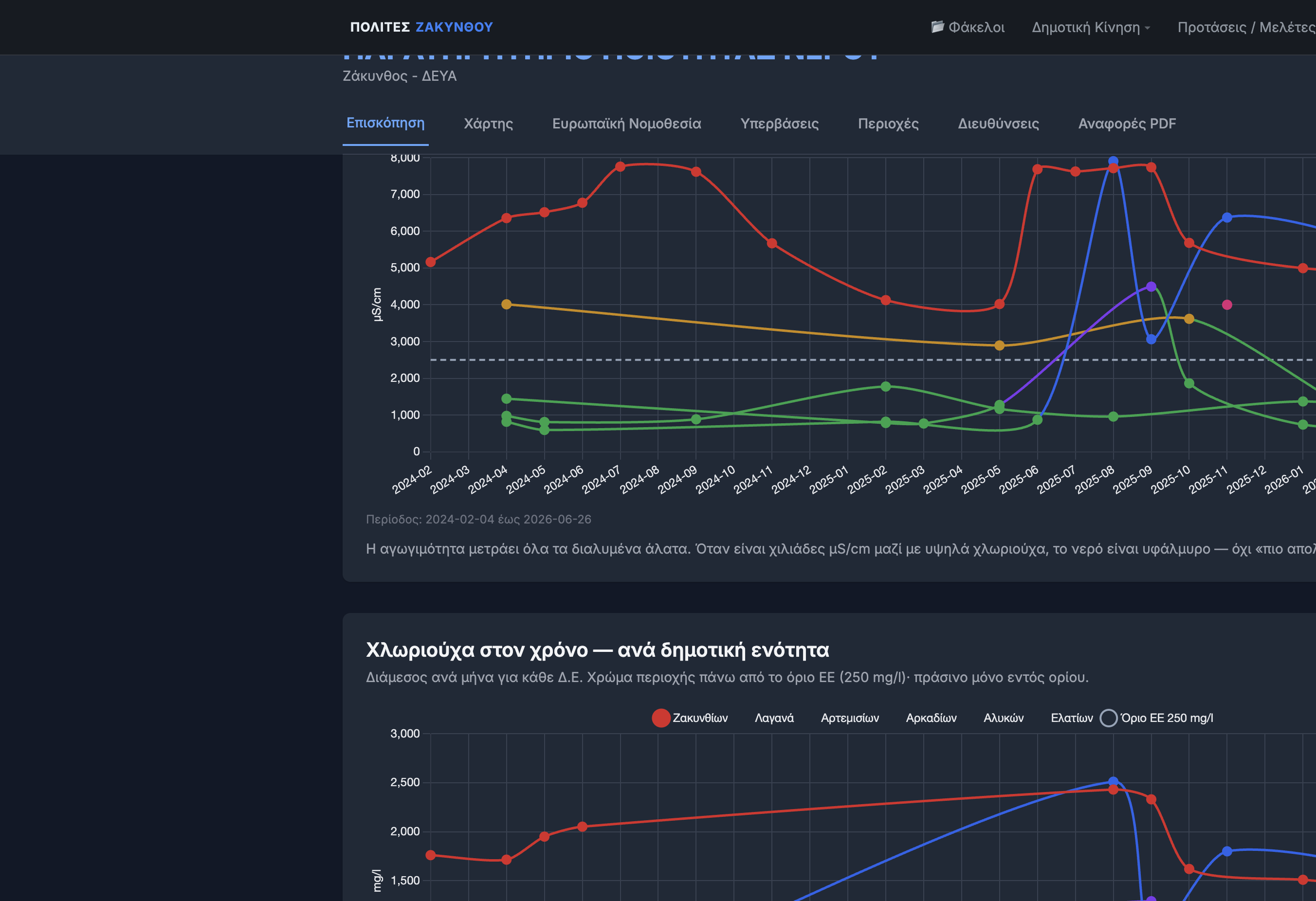
The 2026 analyses are in. Not as notice that reaches people supplied by DEYAZ on its own, as the law requires. As PDFs on the DEYAZ website — the same files we process publicly in the Observatory.
Citizens of Zakynthos came to fill exactly that gap: we transcribe and analyze the data ourselves, publicly, one PDF at a time.
There's one question, and it's the one that matters to anyone who turns on the tap in the city: is the water improving?
No. No improvement whatsoever.
The city's numbers (Municipal Unit of Zakynthos)
- Period
- February 2024 – June 2026
- Conductivity
- 18 out of 18 months above 2,500 μS/cm (median range 4,019–7,755)
- Latest median
- 5,504 μS/cm (June 2026) — more than double the limit
- 6-month trend
- last 3 months 5,504 · previous 3 months 5,682 — flat, above the limit
- Chlorides
- 11 out of 11 months with a measurement above 250 mg/l · latest value 1,650 mg/l
We're not the ones saying this
We re-read all 202 published samples — 84 from 2024, 82 from 2025, 36 from 2026 through 26 June. The measurements are DEYAZ's, not something we made up. The limits are from Directive (EU) 2020/2184: conductivity below 2,500 μS/cm, chlorides below 250 mg/l.
For the city we use the monthly median, not the "worst sample of the year." Even so, the line never dropped to the limit. Not in winter. Not after RAAEY's "management adequacy" certification Y-72/2025, in July 2025. Not with the new 2026 analyses either.
Individual readings go higher: 8,140 μS/cm at the Bochali reservoir on 25 September 2025, 7,989 at another sampling point in the city ("Kantouni," as it's labeled in DEYAZ's own file) the same day. The limit is 2,500.
DEYAZ's own reports also record the water's taste. For the city, they mark it "not acceptable" in 72 of 74 measurements from February 2024 to today — in almost every sample, every month, for two and a half years. And yet the water keeps being distributed, with no official notice that it's unfit. How does it reach you? Tell us.
The island isn't all the same
In the Observatory you'll see a separate line for each municipal unit — here's exactly where the problem is:
| Municipal unit | Months w/ cond. | Above 2,500 | Latest (μS/cm) | Chlorides > 250 | Latest Cl (mg/l) |
|---|---|---|---|---|---|
| Zakynthos (city) | 18 | 18 / 18 | 5,504 | 11 / 11 | 1,650 |
| Laganas | 9 | 4 / 9 | 704 | 4 / 7 | 91 |
| Artemisioi | 9 | 1 / 9 | 1,484 | 4 / 6 | 345.5 |
| Arkadioi | 9 | 0 / 9 | 829 | 0 / 6 | 51.9 |
| Alykes | 6 | 4 / 6 | 2,037 | 4 / 5 | 503 |
| Elatia | 1 | 1 / 1 | 3,998.5 | 1 / 1 | 1,175 |
In Arkadioi, the monthly median of both conductivity and chlorides stays within the two salinization limits, for whichever months have measurements — so those two indicators show no problem there. That doesn't automatically mean "safe to drink in every sample": DEYAZ's own records mark the taste "not acceptable" in Arkadioi too, in 2 of 15 samples with a taste measurement. In Laganas the latest value is low — 704 μS/cm, 91 mg/l — but Kalamaki reached 7,903 μS/cm and 2,510 mg/l chlorides on 31 August 2025. In Alykes the latest chloride value is 503 mg/l, above the limit. In Elatia there's only a single monthly measurement, and it's out of range.
The problem doesn't "affect the whole island equally." It affects the city, consistently, and other units periodically. That's why we show the data broken down by municipal unit rather than an island-wide average — an average would hide exactly this difference.
What chlorides are
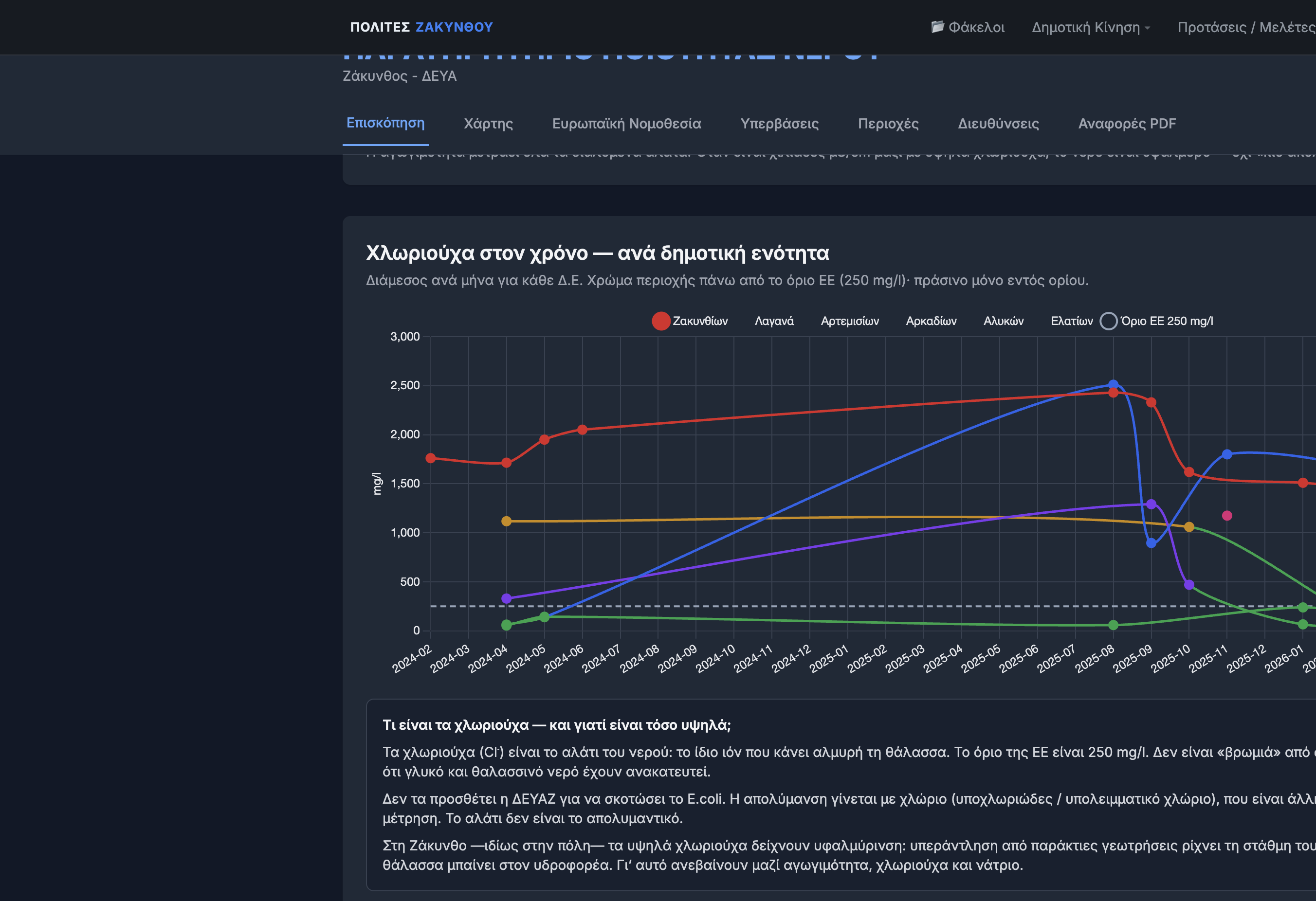
Chlorides (Cl⁻) are the salt in water — the same ion that makes seawater salty.
When conductivity, chlorides and sodium rise together, the water is brackish: over-pumping from coastal boreholes lowers the level of fresh water underground, and seawater moves in to take its place. That's why the city's latest median chloride reading is 1,650 mg/l — more than six times the limit of 250.
What we're asking for
We're not hydrogeologists — but we're fairly confident some exist, somewhere, with the tools to study this problem properly. We don't claim that if the boreholes pumping irregularly get identified, the issue solves itself. We're focusing specifically on extraction because we've seen zero movement from DEYAZ in that direction, and zero coordination between the agencies that should be dealing with the same problem. We see a general disconnect, which leaves DEYAZ free to reduce it, on its own terms, to "salty water = desalination" — without anyone looking at the bigger picture. That's the gap we, Citizens of Zakynthos, are trying to fill: to wake up both the authorities and the public.
The numbers show salinization — over-pumping that lets the sea take the place of fresh water. That raises specific questions, which we're asking DEYAZ to answer publicly:
- The samples show a supply address (e.g. "Bochali," "Kantouni"), not which borehole feeds the network there. Can DEYAZ publish conductivity and pumped volume per individual borehole, so it's clear which specific boreholes are driving the city's readings so high?
- Are there other boreholes — licensed or not — inside the legal protection zone around DEYAZ's own boreholes? We're asking for the relevant inspection to be made public.
- Private ("tourism") boreholes belonging to businesses also operate in the same area. According to the water master plan's own authors, these are estimated to pump more water than all of DEYAZ's public boreholes combined — yet they've never been officially recorded. When will that recording happen?
- After RAAEY's "management adequacy" certification Y-72/2025, what specifically did DEYAZ commit to changing about extraction, and by when?
- Limits on pumping near DEYAZ's boreholes, especially in the summer months: why haven't they been introduced, so that fresh groundwater has time to replenish before it's pumped again — instead of the same over-extraction continuing every year?
The solution already funded skips straight to the next stage
There's already approved funding of €2 million (out of a total project cost of €3.8 million) for a Drinking Water Treatment Unit in the Karanou–Ampelokipon area — that is, exactly for the city, with a capacity of 6,000 m³/day. It isn't officially called "desalination" (unlike three other islands in the same program), but as we showed in our analysis of the same document, the Municipality's own announcement cites a 25% processing loss — characteristic of brackish-water treatment, not a classic freshwater treatment plant.
It's paradoxical: instead of limits on extraction — which would stop the problem at its root — the solution moving forward is to let anyone pump as much water as they want and then "clean it up" with expensive equipment. Taxpayers pay for that choice, while not a single borehole — public or private — gets touched.
And it's not just the cost of the project. As long as extraction isn't limited, residents pay for their water three times over. On conservative assumptions (full calculation here), a four-person household in an area without drinking water for 15 years pays roughly €24,000 in total: ~€5,400 on the DEYAZ bill — for water they can't drink; ~€16,400 on bottled water for drinking and cooking, at just 3 litres/person/day and €0.25/litre; and ~€2,250 in appliance damage (toilet cisterns, taps, washing machines) from the limescale in brackish water. None of that cost appears anywhere in the Treatment Unit's budget — every household pays it alone, every month that extraction stays unlimited.
See the data for yourself
All the charts, the map and the PDFs are in the Water Quality Observatory. The full dossier — RAAEY, funding, timeline — is in the "Water & DEYAZ" dossier (in Greek). You can see the boreholes recorded around Zakynthos on our own water-points map.
DEYAZ has a legal obligation to inform everyone it supplies, at least once a year, without being asked: Article 17 of Directive (EU) 2020/2184, Greek Joint Ministerial Decision Δ1(δ)/ΓΠ οικ. 27829/2023. We don't see it on the bill. When the PDFs are posted, we're the ones reading them.
Values from the PDFs are read automatically (machine processing) and may contain errors. For the official measurement, open the PDF on DEYAZ's analyses page.
Sources & documentation
- DEYA Zakynthou — Water supply analyses (primary PDFs)
- Water Quality Observatory — 202 samples, monthly medians by municipal unit, map
- Limits: Directive (EU) 2020/2184, Annex I — conductivity 2,500 μS/cm (20 °C), chlorides 250 mg/l
- RAAEY decision Y-72/2025 (ΑΔΑ 94ΙΦΙΔΞ-1Μ1) — and our request, ref. I-421091: how a DEYA supplying non-potable water got certified "managerially adequate" (in Greek)
- Previous interview with the data through mid-2025: Y. Kokkinis in Ermis (in Greek)
- "Water & DEYAZ" dossier (in Greek)
- Drinking Water Treatment Unit, ΑΔΑ Ρ7644653Π8-ΛΨ7: our analysis — desalination or not, what the Ministerial Decision actually says (in Greek)
- Over-extraction >300% of needs per the water master plan, unrecorded private boreholes: "Water & DEYAZ" dossier, "The problem's historical depth" (in Greek)
- Cost calculation of ~€24,000 per family over 15 years of non-potable water: "Sewage = Money? Let's do the math — in both directions" (in Greek, with a methods and assumptions note)