Citizens recycled, the Municipality did not: 71.44% landfilled according to RAAEY — what was said at the meeting on cleanliness
The Citizens of Zakynthos followed the meeting and, to keep the public informed, we provide this analysis together with our own view.
On Monday 9 November 2026 the Municipality of Zakynthos invited local organisations and community presidents to the Cultural Centre for a meeting titled "A new era in cleanliness – Circular economy". The whole meeting (2 hours 50 minutes) is on Imera newspaper's YouTube channel (in Greek). Below: what the Municipal Authority said, what the organisations asked, and what the waste collection contract with XENOS ATEVE says about the same issues. Click any timestamp (e.g. ▶ 0:45:27) to watch that exact moment of the video, inside the text. Quotes are our translation.
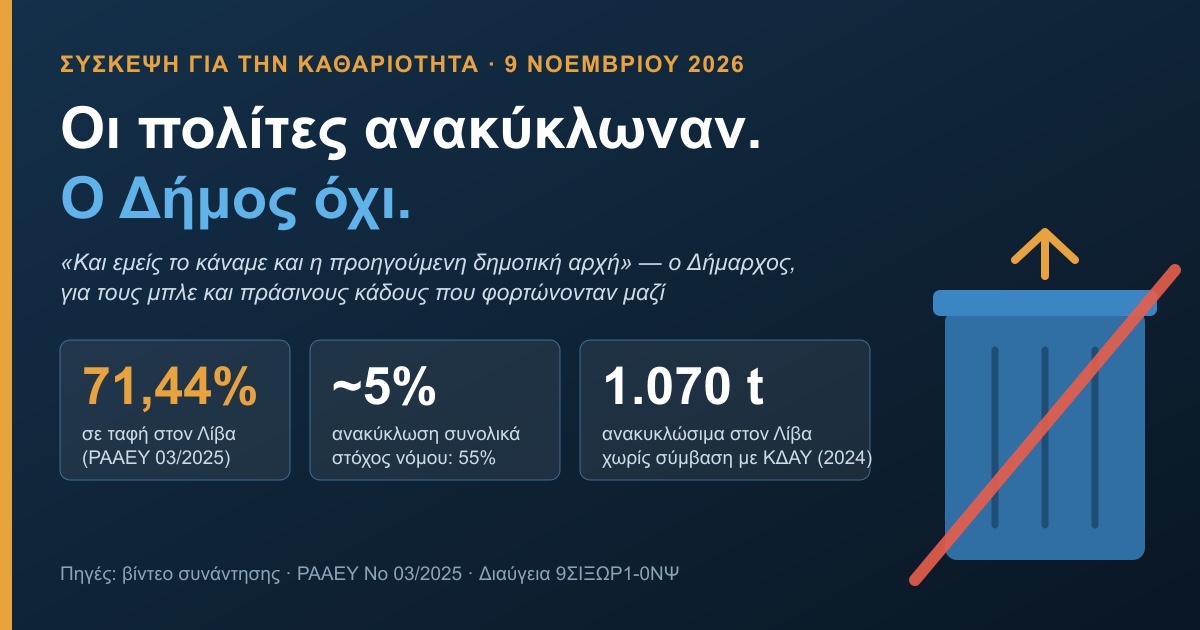
In one paragraph: Citizens recycled; the Municipality did not. At the meeting the Mayor said the blue (recycling) and green (general waste) bins were loaded together: "we did it and the previous municipal authority did it too" ([2:46:58]). The Deputy Mayor said "real recycling" only started on 14/10/2026. The RAAEY report records 71.44% landfilled at Livas and around 5% recycling overall, against a target of 55%. The Livas residual waste landfill is in practice operating as an ordinary landfill, the plant that was supposed to be ready within 24 months from 2021 is not running, and the Region now talks of "a call for the landfill" and a new cell. No data were given on where the 10% that is separated today actually goes. The Local Waste Management Plan is coming to a vote without ever being published, although the law requires citizens to take part in drafting it (Law 4819/2021, Article 58). Finally, the contract with the private contractor already provides for what was announced as "new", such as closed bin lids, and bulky waste collection is being paid for (~€1.18m a year) without a published schedule.
The official picture: what the RAAEY report says about Zakynthos
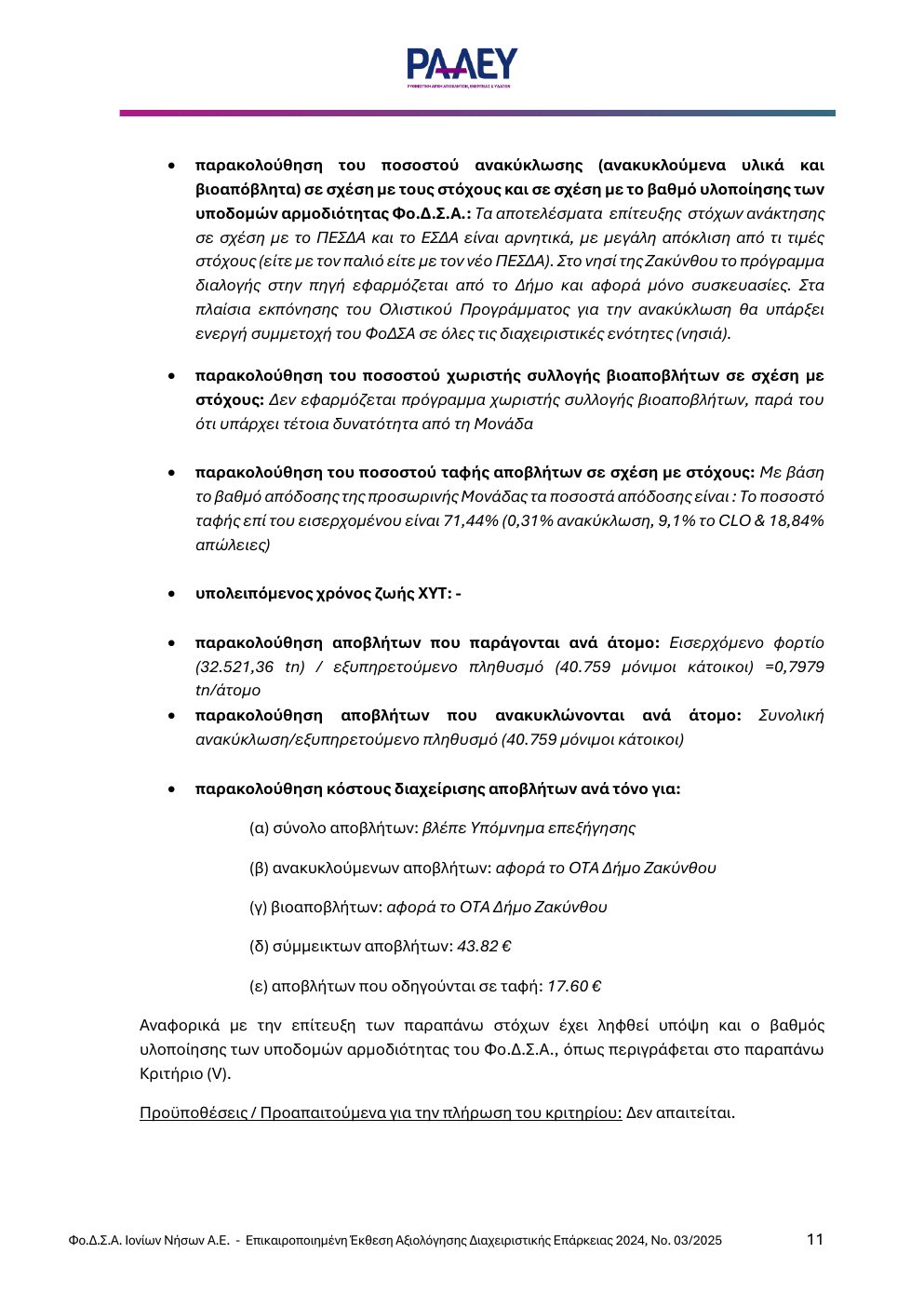
The Regulatory Authority for Waste, Energy and Water (RAAEY) published the Updated 2024 Management Adequacy Assessment Report for the Ionian Islands Solid Waste Management Body (FoDSA), No 03/2025 (original on RAAEY's website, in Greek). The data were submitted by the FoDSA itself. RAAEY records them without "critical assessment" (p. 10). For Zakynthos:
- 71.44% of incoming waste landfilled at the Livas facility: "The landfill rate on incoming waste is 71.44% (0.31% recycling, 9.1% CLO & 18.84% losses)". Incoming waste was 32,521.36 tonnes (p. 11).
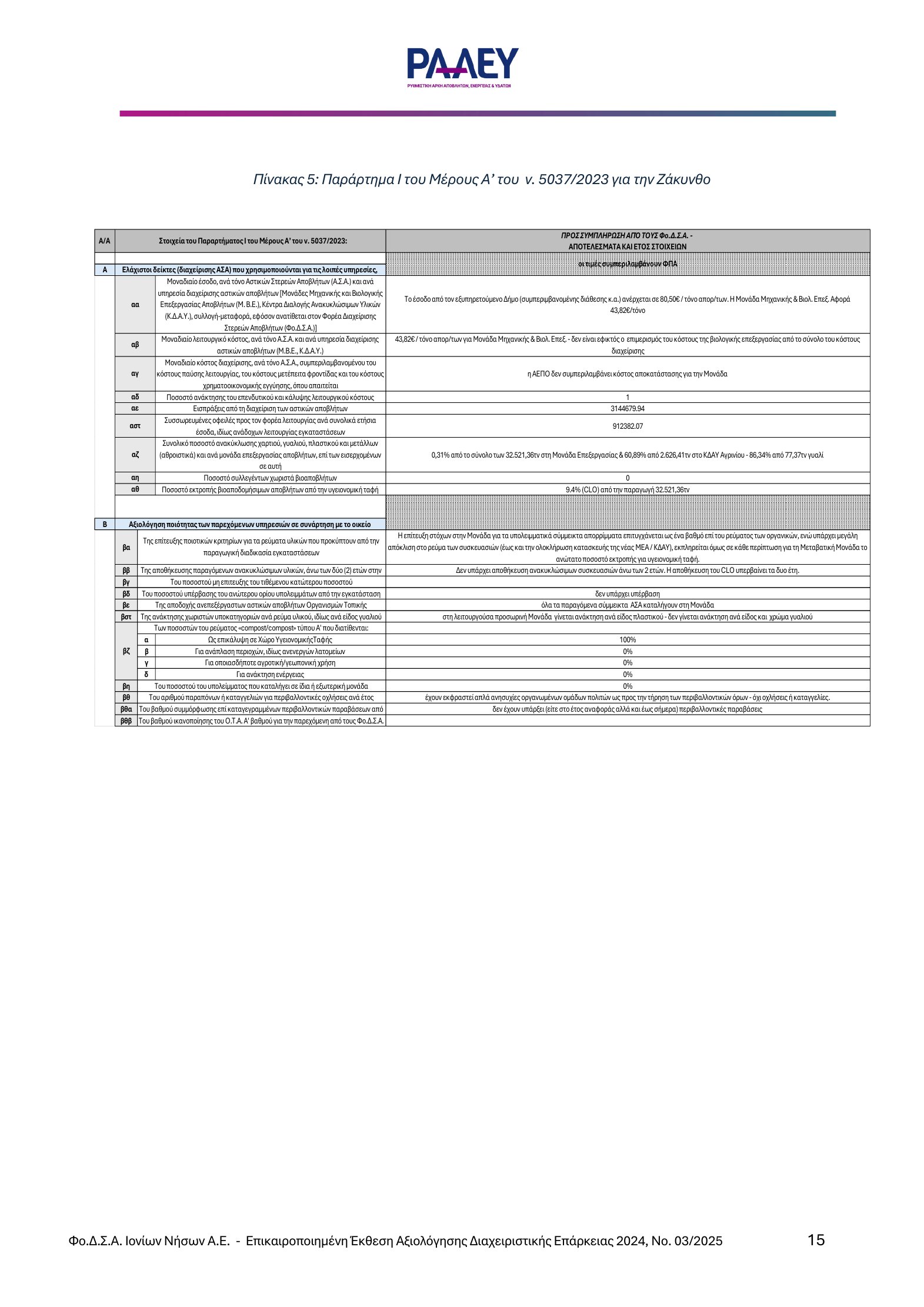
- The "CLO" is buried too. CLO (compost-like output) is the material produced by processing the organic fraction of mixed waste. According to Table 5, 100% of it is used "as cover at a Sanitary Landfill", with 0% for land restoration, agriculture or energy. It has been stored "for more than two years" (p. 15). In practice, then, about 80% of everything that enters Livas ends up landfilled.
- Recycling: 0.31% of the 32,521 tonnes at the Livas facility. In addition, 60.89% of 2,626.41 tonnes sent to the Agrinio materials recovery facility (KDAY) and 86.34% of 77.37 tonnes of glass (p. 15). Adding up the three streams in the table, about 1,770 tonnes were recovered out of a total of about 35,200: around 5%. The legal target for the end of 2025 is 55%.
- "The results in achieving recovery targets relative to the Regional and National Waste Management Plans are negative, with a large deviation". Separation at source "is applied by the Municipality and concerns packaging only" (p. 11).
- Biowaste: "No separate biowaste collection programme is applied, even though the Facility has the capacity for it". Separate collection rate: 0 (pp. 11, 15).
- The Livas facility is described as a "temporary management unit" operating "since 2018" that carries out "baling of the residue for future landfilling" (p. 13).
- On complaints, the FoDSA stated that "organised citizens' groups have merely expressed concerns […] not nuisance reports or complaints" (p. 15). At the meeting, those same associations spoke of legal action in the courts ([1:26:38]).
There is also a contradiction. According to the FoDSA, 2,626 tonnes from the blue bin were recovered at Agrinio at a rate of 60.89%. According to the Municipal Authority, what went to Agrinio "was sent back to us" ([0:22:57]). And after the contract with the Agrinio KDAY expired, the Municipality moved 1,070 tonnes of recyclables to Livas without a contract with any KDAY (see below). Two official versions that do not agree mean citizens need published data, not statements.
Citizens recycled. The Municipality did not.
At the meeting we heard many times that "we are starting from zero" and that people in Zakynthos must "learn" to recycle. From the citizen's side, the picture is the opposite.
Citizens recycled and still recycle. The representative of the Technical Chamber of Greece (TEE) said: "The citizen of Zakynthos knows how to recycle. […] They know what paper is, they know what glass is" ([1:09:27]). Ms Fournogeraki said: "People have not stopped recycling, even though they know the blue bins were emptied together with the green ones" ([2:27:11]). About three years ago, "Kathara Nera" (Clean Waters) collected more than three tonnes of clothes in two months, which went to a factory in Athens ([1:27:36]). Hoteliers separate their materials on their premises ([2:07:35]).
What the Municipality did with all this, according to its own documents and words:
- October 2024: The study by the Cleanliness Directorate (9ΣΙΞΩΡ1-0ΝΨ) states that after the FoDSA's contract with the Agrinio KDAY expired, "the Municipality of Zakynthos is responsible for managing them". It adds that "to date no contract has been signed with any KDAY" and that the volume of recyclables at the airport site "is increasing daily". The solution: moving 1,070 tonnes of recyclables from the airport to Livas.
- October 2024, Municipal Council: A municipal councillor states that "now recycling is being buried in the Livas cell". The Mayor asks him to report it, because if a driver is doing this, it is wrong. It was also said that Agrinio took 4 containers a week, while 34 containers of recyclables were being collected on the island (Ermis, 31/10/2024).
- June–September 2025: A new study to move another 197 tonnes of recyclables from the airport to Livas (ΨΣΝΟΩΡ1-ΝΥ3). €9,502.74 was paid to XENOS (6ΥΑΦΩΡ1-ΕΛ9).
- January 2026: Ermis makes the RAAEY report (No 03/2025) public: 71.44% landfilled at the Livas facility, around 5% recycling overall, separate biowaste collection 0 (PDF; see above).
- 9 November 2026: The Deputy Mayor, on the period before 14/10: "We were emptying […] the recycling on the ground" ([0:41:59]). The Mayor: "everything is loaded into the garbage truck, blue, green bin […] we did it and the previous municipal authority did it too […] everything in, and we took it up there". And on the data: "we should have had the measurable data today, the tonnes we take up […] for recycling, not for the cell, which under different circumstances would have gone to the cell" ([2:46:58]). The Deputy Mayor: "real recycling in Zakynthos started on 14 October 2026" ([2:36:24]).
In the Municipal Authority's own words, then, before 14 October 2026 the contents of the blue bin were mixed with general waste. What counted as "recycling" was whatever Livas separated out from mixed waste ([2:36:24]). And this while the law states that separately collected waste "shall not be mixed with other waste" (Law 4819/2021, Article 23(2)). The "90% mixed waste" in the blue bin is not only the citizens' fault. It is also the result of years in which citizens separated and the Municipality mixed. That is why many people stopped trusting the blue bin.
And the 10% that is "separated out" today? Recycled or buried?
The Deputy Mayor replied that the blue bin materials go through hand sorting at a mobile KDAY installed by MESOGEIOS at Livas "a year ago", and that they "go outside Zakynthos" ([1:18:16]). No data were given to back this up:
- how many tonnes leave, per month and per material,
- which recycling facility they end up at,
- with which documents (delivery notes, receipts).
No data were given on what happens to the remaining 90% of the blue bin. The Mayor said "we should have had today" the tonnage, but did not present it ([2:46:58]). Since 1/1/2022, KDAY operators have been required to calculate, for each municipality, the materials recovered and the contamination (Law 4819/2021, Article 31(3)). The data must be published. Whatever ends up landfilled after sorting is charged a landfill levy per tonne (Article 38), a cost that comes back to residents.
Where Zakynthos stands against European law
The Waste Framework Directive (2008/98/EC, as amended by Directive 2018/851) was transposed into Greek law by Law 4819/2021. It provides:
| What the law requires | Provision | Zakynthos today |
|---|---|---|
| Separate collection at least for paper, metal, plastic, glass | Law 4819/2021, Art. 25(1) (Directive, Art. 11) | Blue packaging bin; according to the Municipal Authority, "real" recycling only since 14/10/2026 |
| Separately collected waste is not mixed | Art. 23(2) (Directive, Art. 10) | Blue and green were loaded together, according to the Mayor |
| Preparation for re-use and recycling of municipal waste ≥ 55% by end 2025, 60% by 2030, 65% by 2035 | Art. 25(2) (Directive, Art. 11(2)) | Around 5% recycling overall; 71.44% landfilled at Livas (RAAEY, No 03/2025) |
| Separate collection of biowaste by 31/12/2022 | Art. 50(1) (Directive, Art. 22) | None; the brown bin is "the next step" |
| Green Points: organised municipal sites where citizens drop off recyclables and used items separately | Art. 29 | Imera asks "when will they be created" (11/11/2026); site designated since 2018 |
| Public participation in drafting waste management plans | Art. 58 (Directive, Art. 31) | The Local Waste Management Plan has not been published |
Citizens do their part: they separate, rinse, take clothes to the associations' bins and keep cardboard at their businesses. The Municipality must do its part: not mix what it collects separately, and show with numbers where every tonne goes. Only then does a discussion about fines make sense. Fines should come after citizens are able to check the Municipality, not before.
What we know as citizens: the residual landfill became an ordinary landfill and everything is buried together
As citizens we have known it for a long time: recycling is not happening, the Livas Sanitary Landfill for Residues (XYTY) is in practice operating as an ordinary landfill (XYTA), the plant has not been completed, and everything is buried together. This is not an impression. It has been written, photographed and said by those responsible themselves:
- December 2017: Livas starts as a "temporary solution" for two years. By 2020 about 80,000 tonnes of baled waste are already stacked there. The then Deputy Regional Governor K. Mothonaiou states: "the situation at Livas is dangerous" (Greenagenda, with photos).
- January 2021: The contract for the plant and the new residual landfill is approved: €12,377,461.72 excluding VAT, with a deadline of 24 months, 18 for construction and 6 for trial operation. Deputy Regional Governor K. Mothonaiou states: "we managed to turn the page on waste management" (Imera, 22/1/2021).
- February 2024: Deputy Regional Governor K. Kapodistrias: "It is a project that started in 2017, we have reached 2024 and it has essentially not progressed. The only things that have progressed are the road […] and the transport of the waste" (Imera, 22/2/2024, with photos).
- March 2024: After visiting the site, the head of "Dynami Elpidas" G. Tsourounakis speaks of "140 thousand bales of waste that unfortunately will be buried". He adds that, according to the FoDSA, recyclables make up 60% of them (Stigma, 27/3/2024).
- March 2025: Regional Governor G. Trepeklis: "construction of the plant has already started and is moving at a rapid pace" (Imera, 20/3/2025).
- May 2026: Deputy Mayor N. Giakoumelos: "The plant at Livas should have been completed in 2019" (Ermis, 14/5/2026).
- June 2026: The president of "Kathara Nera" I. Arvanitaki: "No sorting is happening, no recycling is happening, everything without exception is buried there […] Livas has already become the island's second landfill" (Ermis, 9/6/2026).
- July 2026: The plans change again. The environmental terms are amended for a "three-stream" plant and supplementary funding of about €10m is requested (Imera, 9/7/2026).
- September 2026: The Regional Governor states: "We are waiting for the funding […] and we are ready to proceed with the call for the landfill. Another cell must be built at Livas, because […] there are still issues on plots that are rented from private individuals. These must be moved" (Imera, 10/9/2026).
- 9 November 2026, at the meeting: Deputy Mayor for Education N. Aktypis: "We did not vote for Livas as a landfill. We voted for Livas as a residual landfill […] with a plant, with sorting, with recyclable materials, not everything in the cell" ([1:51:59]). St. Skiadopoulos: "Livas is a modern rubbish dump. Nobody told me, I saw it" ([1:41:21]). The Deputy Mayor for Cleanliness set as a "central goal" that the cell opened at the end of the 2025 season "be used for the purpose it was created for" ([0:51:05]).
The images are public. Photos of the bales and the waste at Livas have been published by Greenagenda (2020), Imera (2024) and Stigma (2024). St. Skiadopoulos said at the meeting that he goes up the mountain and publishes photos of the site ([1:33:13]). The planning, funding and announcements came from the Municipality, the Region, the FoDSA and the government, through the EU Partnership Agreement (ESPA). The plant that was supposed to be ready within 24 months from 2021 is still not operating. The "call for the landfill" and "another cell" are now the official agenda.
Skopos reminds us every day
We have no good experience of elected officials' promises on waste. The Skopos landfill, inside the National Marine Park, is still there. The Court of Justice of the EU convicted Greece over the site for the first time on 17/7/2014 (C-600/12) and a second time on 9/10/2025 (C-368/24). The second conviction brought a €5.5m lump sum and €12,500 for every day until the site is restored. Twelve years after the first ruling, the site has not been restored. There are only announcements, the latest promising completion "at the end of 2026 or early 2027" (Imera, 10/9/2026). On our site visit in October 2026 we found "a complete lack of activity" (article 319, in Greek). The fine running, day by day: Skopos tracking page.
With this history, citizens have every reason to demand numbers, not assurances, about Livas.
Bottled water: a mountain of plastic created by the lack of drinking water
First on the blue bin list, the Deputy Mayor put "plastic water bottles", provided they are "clean" ([0:35:31]). Ms Arvanitaki explained: "even the water bottle, which is considered the cleanest material, cannot be recycled at the recycling plants if it is not in excellent condition" ([1:21:16]). Bottles with water left in them, with caps on, mixed with general waste: all of this ends up landfilled.
In Zakynthos this stream is huge for a specific reason: nobody drinks tap water. DEYAZ's own analyses show repeated exceedances of conductivity and chlorides. RAAEY has issued a recommendation to DEYAZ over its water quality monitoring programme (article 320, "Water & DEYAZ" file, in Greek; our interview on it in English). Households, hotels and schools buy bottled water. That plastic, with 71.44% landfilled at Livas according to RAAEY and a blue bin that until recently was mixed with general waste, largely ends up in the ground.
The law puts waste prevention first in the hierarchy, before recycling (Law 4819/2021, Article 4; Directive 2008/98/EC, Article 4). The best bottle is the one that never has to be bought. Water and waste are therefore the same problem and need a joined-up response from the Municipality. Drinkable tap water means less plastic, less landfill and lower costs for every resident. A Local Waste Management Plan that ignores this leaves out one of the island's biggest waste streams.
Why it happened now: what the law requires before the vote
The law requires citizens' participation before two texts are voted on, and both were mentioned at the meeting: the Local Waste Management Plan (TSDA) and the cleanliness rules with their fines.
- The TSDA is mandatory for every municipality (Law 5314/2026, the new Local Government Code, Article 319(2)(b)). It is approved under Article 56 of Law 4819/2021, after the FoDSA gives its opinion within one month, and is submitted to the Electronic Waste Register.
- Citizens take part in drafting it. Law 4819/2021, Article 58 "Public participation", which transposes Article 31 of Directive 2008/98/EC, states: "Stakeholders, authorities and citizens shall participate in the drafting of waste management plans […] and shall have access to them after they are drafted". It also states that the plans "are posted on a website accessible to citizens".
- Rules with fines require 15 days of consultation. The Cleanliness Regulation is mandatory (Law 5314/2026, Article 319(1)(c)). For regulatory decisions on cleanliness (Article 318(1)(ag)), the municipal council takes into account the proposals of the bodies with which it "enters into consultation". The draft decision "is posted for public consultation for at least fifteen (15) days on the municipality's website". The department drafts a report on the comments before the vote (Article 318(2)). Fines are set by such decisions (Article 318(3)).
At the meeting the Deputy Mayor said the study for the management plan has been "completed" and "is coming to a vote at the next or the following Municipal Council". He added that it is "a tool we will need within the framework of the programmes that are coming", i.e. for funding from the Region ([0:29:31]). He also handed out a leaflet containing "all the fines" ([0:40:17]).
The Municipality's website has consultation posts for other plans: the Sustainable Urban Mobility Plan (call to stakeholders and three thematic consultations, 2024–2025) and the tourism strategy (2025). For the TSDA there is none: no draft, no call, no comment deadline. The Cleanliness and Recycling Regulation was posted on 7/7/2026 dated "August 2024", without a call for comments or a consultation deadline.
This also explains the format of the meeting. The plan was presented as finished a few weeks before the vote. Its text was not presented and has not been published. The law requires citizens to take part in drafting the plan. Here "participation" came at the end, in one evening, with no document for anyone to comment on. Many of the questions left unanswered (Green Points, bulky waste, bin placement, Livas) are exactly those a TSDA should have answered in public consultation.
What the Municipal Authority announced
The main presentation was given by Deputy Mayor for Cleanliness Nikos Giakoumelos ([0:19:08]–[0:54:49]). Mayor G. Stasinopoulos opened ([0:11:18]) and closed the meeting ([2:44:31]). The main points, in their words:
- Review: 1,400 new green and blue bins and more than 700 repaired ([0:27:04]), GPS on all vehicles and a fleet washing facility ([0:24:38]), 24-hour security at the entrance of the transfer station and the depot, "restoration of the old transfer station and installation of a new transfer station" ([0:25:59]), new bin placement in the town ([0:28:05]).
- The contract with the private contractor: "We contracted a private company for €3,629,000, VAT included […] for collecting the green bin, washing the bins, sending the waste to Livas […] and cleaning the bin sites. […] Numbers get thrown around, people hear them, they always talk about 10 million. That is not the reality" ([0:30:15]).
- Recycling: "Real recycling started on 14 October. Many wondered and said: but what was happening before? What I told you was happening. We were emptying […] the recycling on the ground, we were feeding the rodents" ([0:41:59]). "Of 100% of the blue bin, 90% is mixed waste. And of the 10% we separate out, 90% is paper. So we are starting from zero" ([0:43:00]). Closing, the Mayor: "Because now everything is loaded into the garbage truck, blue, green bin, because we didn't even have drivers, and we did it and the previous municipal authority did it too. We didn't discover America, let's tell the truth […] everything in, and we took it up there" ([2:46:58]).
- Lids: "From tomorrow they will start closing the bin lids. […] People will press the mechanism with their foot" ([0:45:27]).
- Collection schedule: "The time has come to announce the green and blue bin collection schedule, so that citizens finally know when the service they pay for is provided" ([0:44:03]).
- Bulky waste: "Bulky waste goes to the private contractor, who is paid for it" ([2:04:03]). The citizen "phones the bulky waste department as before" and the Municipality passes the address to the contractor ([2:04:35]). For the schedule he referred to the new Deputy Mayor in charge, Mr Chartas, who "was appointed a week ago" and will announce "everything, the planning" ([2:02:35]).
- Fines: 40,000 leaflets with instructions and fines ([0:39:13]). A business throwing recyclables into the green bin "will get €50 per box" ([2:36:01]).
- Plans: Underground bins, press containers, composters ([0:49:00]) and a brown bin for organic waste ([1:20:15]). The Local Management Plan is coming to the Municipal Council ([0:29:31]). Goal: cutting waste by 50% by the end of the term ([2:43:49]). 81 permanent staff positions in cleanliness ([2:46:16]).
What the organisations asked — and what went unanswered
- Green Points. The president of "Kathara Nera" I. Arvanitaki asked for "green points to be designated, an issue on which we have also fallen behind" ([1:17:00]). St. Skiadopoulos (former president of "Vrachionas") said the approved Livas studies provide for "five green points on the island", with security and staff ([1:34:00]). The Municipal Authority did not say when or where they will be built. The next day Imera asked the same question: "When will the Green Points be created?" (Imera, 11/11/2026).
- Bin placement study. The TEE representative Mr Mothonaios asked for the placement study and the number of bins per municipal unit to be presented ([1:10:00]). The answer was "we have presented the project for 40 new bin sites" ([1:58:36]). No study was presented.
- Where citizens take bulky waste. A member of "Kathara Nera" described how a resident of the Pantokratoras–Laganas area asked the cleaning staff where to take bulky waste and was referred to the contractor. There, the answer was: "yes, we'll come, but first you have to inform the Municipality" ([2:00:49]). Deputy Mayor for Education N. Aktypis said "there isn't a ravine without bulky waste" and that a site must be found for it ([1:53:36]). The president of Alykanas also asked for a site for bulky waste ([2:38:24]).
- Cleanliness around the bins. The president of Alykanas said the contractor "collects the rubbish but never cleans the ground" and that he himself goes out "with a broom and dustpan" after they pass ([2:38:34]). Ms Arvanitaki mentioned the "juices" dripping from bins onto squares and pedestrian streets ([1:29:04]).
- Livas. "Kathara Nera" said they ask to visit the site and are referred by the FoDSA to the technical services, and from there to MESOGEIOS ([1:26:00], [2:01:53]). No MESOGEIOS representative had been invited ([1:51:00]). The Municipal Authority said MESOGEIOS asks for "2.5 to 3 million euros a year" and that the Municipality will re-examine "the prices and the management" ([1:57:53]).
- Incentives, not just fines. Ms Arvanitaki ([1:22:57]) and Ms Fournogeraki ([2:27:41]) asked for organisation, information and incentives (e.g. lower municipal charges) to come first, and fines last. Ms Fournogeraki also asked where citizens should take oils, paints and cigarette butts, since they are not allowed in the bins ([2:29:39]).
What the contract says about the same issues
The contract with XENOS ATEVE (contract ID, ΑΔΑΜ 26SYMV019492613) has been in force since 14/7/2026. The contractor's obligations are described in the technical description of study 61/2025, within tender notice 25PROC017953723 (pp. 48–55).
1. What the "€3,629,000" is
The contract budget (tender notice, p. 55) has nine lines with an annual cost of €3,887,976.43 excluding VAT. The contractor bid €7,759,060.00 for two years, against a budget of €7,775,952.86: a 0.22% discount. From this:
| What we count | Amount incl. VAT |
|---|---|
| One year, without the four bulky waste lines | ≈ €3,628,000 |
| The four bulky waste lines, one year | ≈ €1,182,000 |
| One full contract year | €4,810,617 |
| The whole contract (2 years) | €9,621,234.40 |
| With the up-to-50% extension the contract allows | up to ≈ €14.4m |
The amount the Deputy Mayor gave matches the first line: one year without bulky waste. The "10 million" going around is the total contract value for two years. Both numbers are correct, but they measure different things. As of 15/10/2026 the Municipality had issued two payment warrants for the contract: €224,854.41 (99ΩΨΩΡ1-8ΔΠ, 29/9) and €312,650.50 (6ΧΥΦΩΡ1-ΓΨΨ, 15/10). Details in the waste collection file (in Greek).
2. Bulky waste is being paid for, but no schedule or collection points have been announced
Under the contract, the contractor collects bulky waste and branches five days a week all year round, with two tipper trucks, a JCB and a grab. It collects them "from various collection points to be designated by the Municipality". It may also make up to 50 extra trips a year to sites where bulky waste and rubble are dumped illegally (p. 52). Bulky waste has four lines in the budget: collection and processing, for high and low season (p. 55). With the contractor's discount and VAT, they cost about €1.18m a year.
At the meeting it was said that citizens phone the "bulky waste department" ([2:04:35]), without any number, pick-up schedule or "collection points" being given. These will be announced by the new Deputy Mayor ([2:02:35]). It was also said that a citizen who puts their mattress out on the street, instead of reporting it to the department, "will suffer the consequences written in the leaflet" ([2:41:26]). And the Laganas resident who asked the staff got two different referrals ([2:00:49]).
In fact, the procedure is already written into the Municipality's Cleanliness Regulation (Article 10). Bulky waste "is collected by the Municipality upon request, by the Cleanliness Directorate". Citizens put it out on the street only "on the morning of the day they were notified". For bulky waste dumped on plots and in streams, a fine of €150 to €500 is provided. What is missing is the part that concerns the Municipality: a phone number, a schedule and collection points, publicly announced.
3. The collection schedule should have been public from the start
"The schedule for carrying out the contract work shall be made known to the public in accordance with the instructions of the Cleanliness Directorate of the Municipality of Zakynthos."
— Tender notice, p. 49
At the 9/11 meeting the Deputy Mayor said "the time has come" to announce the schedule and that "now the contractor is obliged to apply the schedule the Municipal Authority tells it" ([0:44:03]). So the schedule is set by the Municipality, and until then it had not been published. On 30/10 the Deputy Mayor himself had said that he learns of collection problems from the community presidents, "because it is not easy to have complete information every day" (Imera, 30/10/2026). Yet the contract requires GPS on every contractor vehicle (pp. 51–52) and daily reporting of problems to the Cleanliness Directorate (p. 49).
4. Lids have been the contractor's obligation since 14 July
"Waste collection bins (upon instruction by the contracting authority) must be covered with their lid and remain closed between the temporary storage of waste and its collection, under the contractor's responsibility. The contractor is obliged, with its own staff and means, to clean the area under and around the waste bins within a radius of 1 metre."
— Tender notice 25PROC017953723, p. 50
Page 49 also provides that the contractor's workers "shall ensure the proper functioning" of the bins ("wheels, brake, lid, pedal"). For closed lids, the contract only required one "instruction" from the Municipality. The "from tomorrow" announcement came almost four months after the contract started. The same article obliges the contractor to clean within a one-metre radius around every bin. That is exactly what the president of Alykanas said is not happening.
5. Two transfer stations?
The contract requires the contractor to have "a licensed Transfer Station in operation" for transporting waste and bulky waste to Livas (p. 53). The Municipality pays about €1.16m a year excluding VAT for this. At the meeting, however, the Deputy Mayor presented as the Municipal Authority's own work the "restoration of the old transfer station and installation of a new one", with 24-hour security at its entrance ([0:25:59]). In addition, on 30/9/2026 the Municipality paid for the hire of a tractor unit "for transporting waste to Livas" (Ψ1Θ7ΩΡ1-ΝΞΤ). It has not been made public which waste goes through which station, nor whether the transport the Municipality does with its own means is deducted from the contractor's invoices.
6. The tool for "dirty" blue bins already exists
The contract provides that if a blue bin contains non-recyclable waste, the contractor, after informing the Municipality, empties it with the green bin truck. That way the whole recycling load is not spoiled (p. 50). With 90% of blue bin contents being mixed waste, according to the Deputy Mayor himself, the obvious question is how many times this provision has been used since 14 October.
Green Point: site designated in 2018
The request for Green Points is not new. From the public record:
- 19/11/2018: The Municipal Council (decision 392/2018, ΩΤΒΓΩΡ1-ΤΡΤ) unanimously approves siting a "Green Point" on the municipal plot near the main gate of the Zakynthos stadium. The project belongs to the Ionian Islands Region and is funded by Interreg Greece–Albania 2014–2020 (project "WASTE RREACT").
- 16 and 29/7/2021: The Finance Committee decides the Municipality will take part in the ESPA call "Creation of Green Points and their networking" (63ΔΧΩΡ1-Ψ4Ξ). It approves studies worth €2,206,952 for the operation "Creation of a network of Green Points and their networking in the Municipality of Zakynthos" (decision 249/2021, 9446ΩΡ1-ΑΙ8). Of that, €2,108,000 is for "Mobile equipment for separation at source".
- 21/3/2022: Deputy Regional Governor K. Kapodistrias states that the environmental study and the archaeological service's approval have been issued and that the Finance Committee approved the tender. The Green Point will be built "near the facilities of the Cleanliness Association at the airport", on a 500–600 m² plot, after an eight-month delay over choosing the site (Imera, 21/3/2022).
- 6/5/2022: The president of Kalamaki: "In Zakynthos the Municipality has not managed to create a green point anywhere to gather all the bulky waste" (Stigma 97.6).
- 13/1/2023: Second amendment of the Region–Municipality programme agreement for the Interreg project (6ΠΥ3ΩΡ1-Ο2Α), with an extension and a budget of €94,750. The Municipality undertakes to hand over the site "free of any encumbrance" and to ensure the Green Point operates after completion. A third amendment follows on 6/9/2023 (63ΒΓΩΡ1-9ΣΨ), with a budget of €159,294.37.
- 9/11/2026: At the meeting, organisations again ask for Green Points ([1:17:00], [1:34:00]). The Municipal Authority mentions no Green Point in operation and no timetable.
A staffed Green Point would answer exactly the question "where do I take it" for mattresses, furniture, oils, paints, batteries and electrical appliances. It was the question that kept coming back throughout the meeting. It would also be the natural site for the bulky waste "collection points" the contract provides for.
Underground bins: the study already exists
In the "updated plan" the Deputy Mayor mentioned "underground bins in the town and villages" ([0:49:00]). It is an issue we have covered repeatedly and in detail: in the article on the Open Mall underground bins (in English), in the IonianRadio interview and in proposal 11 of our waste collection study (both in Greek). The key points:
- November 2018: The study for Open Mall sub-project 6 provides for 8 underground bins of ~3,000 litres in the centre, with fill-level sensors. It includes construction drawings and a cost of €119,040 incl. VAT (tender ΨΔΙΒΩΡ1-Ζ92, pp. 125–140). It is included in ESPA in 2019.
- 2022–2023: The tenders attract no bids for the bins.
- 10/10/2024: The Municipal Committee (decision 383/2024) decides the underground bins will not be built and moves the money to another sub-project. The so-called "pi" (Π-shaped) bin enclosures were installed instead.
- August 2026: Our study costs bin undergrounding at ~€16,600 per site, based on actual contracts in Thessaloniki and Skiathos. For 40 sites in the centre the cost is ~€665,000, and for 80 sites including the main resorts ~€1.33m.
- The contract with the private contractor is already ready: if the Municipality installs underground bins, the contractor must empty them and provide a crane truck (tender notice, pp. 48–49). And the Cleanliness Regulation already provides for underground bins and fines for misusing them.
The same goes for Green Points: in 2021 the Municipality approved studies for a network of Green Points with a budget of €2.2m (9446ΩΡ1-ΑΙ8). We hope we will not have to pay again for studies that have already been done. The new TSDA must start from them, not commission them again.
What the Municipality does and does not do
There are improvements, and even critical organisations acknowledged them at the meeting: bins, repairs, washing, and "by general admission" better collection ([1:48:40]). But the discussion showed that the Municipal Authority is asking citizens for discipline before building the system that would allow them to be disciplined. Missing are:
- a published collection schedule by area, which the contract has required since July,
- a published schedule and collection points for bulky waste, which the contractor is already being paid for,
- public consultation on the TSDA before the vote, as Article 58 of Law 4819/2021 requires,
- a Green Point, eight years after its site was designated,
- public data on what Livas receives, what it separates and what it sends off the island,
- checks on the contractor for what the contract already requires: closed lids, cleaning around bins, returning bins to place.
What we ask as Citizens of Zakynthos
The citizens of Zakynthos ask the services to do their job properly and as the law requires. To check the contractor we pay, not to mix what we collect separately, and to publish the data.
We ask local officials to be, above all, responsible citizens and to set an example for the citizens who supported them. This is about our future and our children. Every decision must be guided by the resident and citizen, not merely show that work is being done on paper. We have lived through this with "drinkable" water. We do not want to live through it again with "recycling".
Our questions to the Municipality
- When was the contractor given the "instruction" for closed lids (p. 50 of the tender notice), and how is cleaning within a one-metre radius around bins checked? Have penalty clauses been applied?
- When will the collection schedule for the green bin, blue bin and bulky waste be published per community, as the contract requires?
- What are the bulky waste "collection points" the Municipality has designated to the contractor, what is the bulky waste department's phone number, and what is the pick-up schedule?
- What became of the Interreg Green Point (Council decision 392/2018) and the €2.2m 2021 proposal for a network of Green Points? Were they approved, delivered, lost?
- Which transfer station does the contractor use today, and which does the Municipality use? Is the transport the Municipality does with its own means deducted from the contractor's invoices?
- How many times since 14/10 has the provision for collecting "dirty" blue bins with the mixed waste truck been used?
- Will the draft TSDA be posted for public consultation before it reaches the Municipal Council? Will the FoDSA's opinion be published?
- By which decision was the Cleanliness and Recycling Regulation ("August 2024") adopted? Are the fines in the leaflet based on it? If they change, will they be put to 15-day public consultation, as Article 318 of Law 5314/2026 now requires?
- Will the 2018 underground bin study and the 2021 Green Point studies be used, instead of commissioning new ones?
- What became of the 1,070 tonnes (2024) and 197 tonnes (2025) of recyclables moved from the airport to Livas when there was no contract with any KDAY?
- How many tonnes are recovered at the mobile KDAY at Livas, which facilities are they sent to, and how much residue is landfilled, as must be recorded per municipality since 2022 (Article 31(3) of Law 4819/2021)?
- Will the Municipality publish monthly data: tonnes per stream, recyclables leaving the island, contractor invoices per service?
The transcription was produced automatically (Whisper) from the meeting video and the quotes were checked against the video. In a few places the audio is not clear. Speakers' names come from the video and from Imera's report (10/11/2026). All quotes are our translation from Greek.
Sources (in Greek): Tender notice 25PROC017953723 (study 61/2025, pp. 48–55) · Contract 26SYMV019492613 · Diavgeia: ΩΤΒΓΩΡ1-ΤΡΤ, 63ΔΧΩΡ1-Ψ4Ξ, 9446ΩΡ1-ΑΙ8, 6ΠΥ3ΩΡ1-Ο2Α, 63ΒΓΩΡ1-9ΣΨ, 99ΩΨΩΡ1-8ΔΠ, 6ΧΥΦΩΡ1-ΓΨΨ, Ψ1Θ7ΩΡ1-ΝΞΤ · RAAEY, Updated 2024 Management Adequacy Assessment Report, Ionian Islands FoDSA, No 03/2025 · Legislation: Directive 2008/98/EC as amended by Directive (EU) 2018/851 · Law 4819/2021 (Government Gazette A 129), Articles 23, 25, 29, 31, 38, 50, 56 and 58 · Law 5314/2026 (Government Gazette A 103), Articles 318–319 · Municipality of Zakynthos Cleanliness and Recycling Regulation · Diavgeia (recyclables): 9ΣΙΞΩΡ1-0ΝΨ, ΨΣΝΟΩΡ1-ΝΥ3, 6ΥΑΦΩΡ1-ΕΛ9 · Ermis: 31/10/2024, 15/1/2026 · Imera: 10/11/2026, 11/11/2026, 30/10/2026, 21/3/2022 · Stigma 97.6, 6/5/2022.
Follow-up: Livas: +43% waste, +1.7% visitors, plant “only at the foundations” (Municipal Council, 11/11)
Related (in Greek): "Waste collection by a private contractor" file · Waste collection with own resources after 2028: our study · The study with all the data
Translated from the original Greek article.