Interview with Ermis: RAAEY's recommendation to DEYAZ and drinking water
The answers of Giannis Kokkinis, head of the municipal movement "Citizens of Zakynthos", to questions from Olga Gkouskou for the newspaper Ermis (5 November 2026), on the recommendation issued by RAAEY (the Regulatory Authority for Waste, Energy and Water) to DEYAZ, the Municipal Water Supply and Sewerage Company of Zakynthos. The background and the full text of the decision are in our article on Y-43/2026 and in the "Water & DEYAZ" file (both in Greek).
1. How do you assess RAAEY's recommendation to DEYAZ?
I consider it an extremely important development, because it brings to light a reality that we have been trying to expose for a long time.
This development did not come about by itself. It was preceded by years of effort: requests, complaints, documentation and constant communication with the competent authorities.
Since 2020 I have been trying to get a clear answer to a simple (rhetorical) question: is the water that reaches our tap drinkable?
I have repeatedly contacted DEYAZ, the Ministry of Health, the Region, the Decentralised Administration, the National Transparency Authority and RAAEY. I have submitted detailed reports, laboratory data and specific complaints.
I have even sent the competent authorities, including RAAEY, video clips of public statements by elected officials, to strengthen the documentation of the case and to set public assurances against the available data.
It is significant that both RAAEY and the competent Water Directorate dealt with these specific issues and the reports I had submitted in dedicated board meetings.
RAAEY's decision itself records six successive reminders to DEYAZ, from February to September 2026, to fulfil specific obligations for monitoring water quality.
The Authority even states that the absence of the necessary data "is not merely a formal omission" but "substantially hinders" supervision.
Even more revealing is that DEYAZ had sent laboratory analyses for the first half of 2026, but RAAEY states that it cannot assess whether the samples were taken at the right points, at the right frequency and for the required parameters, because it does not have the necessary monitoring programme.
In other words, the supervisory authority cannot fully verify whether the water quality control system works as the law requires.
But I want to stress that my own research is not limited to administrative documents.
I have studied DEYAZ's own laboratory analyses in depth. We have collected and examined 202 published samples, from February 2024 to June 2026.
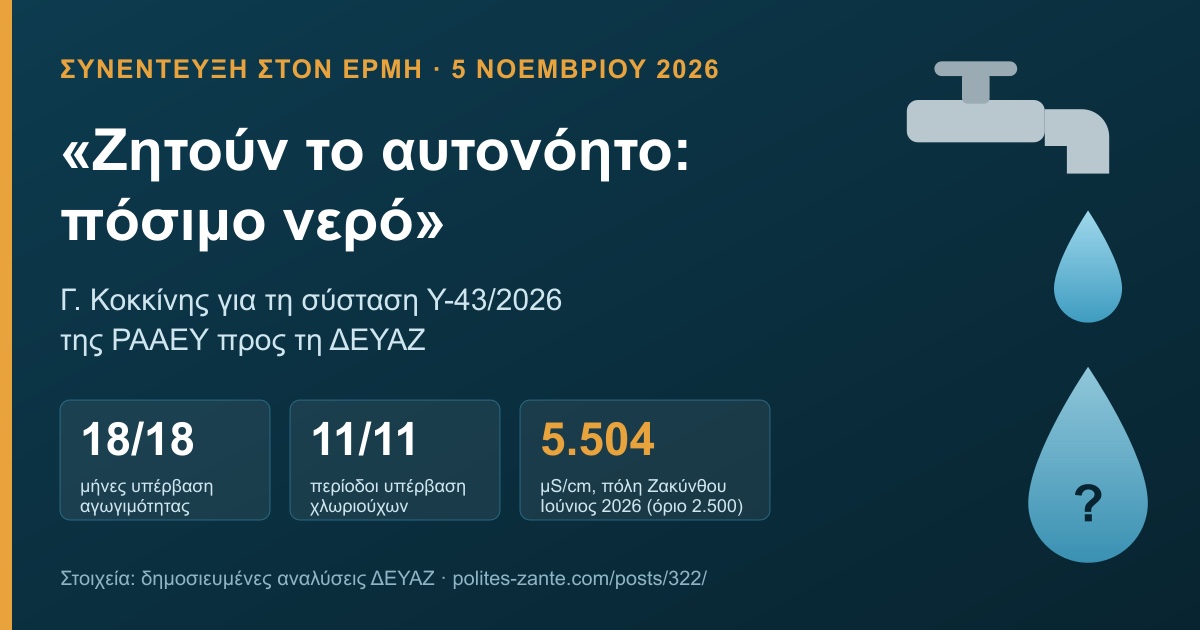
In the town of Zakynthos, electrical conductivity exceeds the parametric value of 2,500 μS/cm in all 18 of the 18 months we examined. Chlorides exceed 250 mg/l in all 11 of the 11 periods with available measurements. In June 2026, conductivity of 5,504 μS/cm and chlorides of 1,650 mg/l were recorded.
These are not my own laboratory results. They are data published by DEYAZ itself.
And here a huge contradiction arises. While the management publicly assures us that the water is fit for human consumption, its own published analyses show repeated exceedances of parametric values.
These findings raise serious questions about compliance with drinking water standards and require official answers.
RAAEY did not rule on whether the water is drinkable in its decision. That must be clear. But its inability to fully assess the monitoring system, combined with the exceedances that emerge from the analyses, makes the need for answers even more urgent.
2. Do you think DEYAZ will respond, and what will happen with the threat of a fine?
Here I want to clarify something, because I think it is particularly important.
We are no longer at the stage of a simple warning that there might be consequences at some point. RAAEY has already imposed the sanction of a recommendation with decision Y-43/2026.
There are two distinct stages in the procedure.
The first is the sanction of a recommendation, which has already been imposed. The second is a financial penalty, if non-compliance continues and the legal conditions are met.
So DEYAZ is already facing an official supervisory sanction. The possibility of a fine is the next stage.
It will be interesting to see whether DEYAZ manages to avoid the financial consequences this time too. Because we have grown used to hearing many explanations, many assurances and many promises. At some point, though, there have to be consequences.
I also want to underline something that often gets lost in the news cycle.
We are not talking about a provisional finding on a project. We are not talking about the pending issues of the Loucha–Giri pipeline, the telemetry, or the Filikoi pipeline, where we are discussing projects, contracts, delays and technical issues.
Here we are talking about something far more fundamental. We are talking about the very core of DEYAZ's mission: supplying drinking water.
When a utility's ability to monitor, assess and document the quality of the water it supplies is called into question, we do not simply have one more administrative or technical problem. We have an issue that directly affects every household, every business and every resident of the island.
And this raises another serious question for all the previous managements and Boards of Directors.
So many meetings, so many studies, so many budgets, so many millions in funding. Was there no one to look seriously at the analyses themselves and ask whether the water meets the standards set by law?
Can an organisation be effective at securing funding and presenting projects, yet be unable to correctly assess the results of the laboratory analyses it publishes itself?
If it cannot, then what exactly are we assessing when we talk about management adequacy?
I am not trying to get a fine imposed on DEYAZ. I am trying to ensure there is an organisation that knows what water it supplies, can prove it, and takes responsibility for it.
3. From here on, how should DEYAZ proceed?
I believe there needs to be a comprehensive review of how the utility operates.
It is not enough to treat this case as one more pending administrative matter. We need to examine whether DEYAZ really has the capacity to manage such a critical public good.
We need to know where the water comes from, the condition of every borehole, which areas are supplied by each source, what is happening in the networks, and what the real quality of the water is at the points of consumption.
We also need to examine whether DEYAZ has the scientific and technical expertise to interpret laboratory analyses correctly and to apply the law.
And this raises a broader question: is the current Board of Directors ultimately the properly qualified body to take all these critical decisions?
I do not say this to question its members personally. I say it because we have to look at the result. To date, despite the meetings, the decisions, the studies and the announcements, we have not come any closer to what should be the first and fundamental priority: having drinking water.
So perhaps the way these decisions are taken needs to change? Perhaps people with the necessary scientific, technical and administrative expertise need to be meaningfully involved?
If DEYAZ lacks this expertise, it must acquire it, with the help of independent scientists and competent bodies.
And here a question arises that some might not even want us to discuss.
Could DEYAZ's inability to meet its most basic obligations eventually lead to developments that many today consider unthinkable?
At national level, discussion has already opened on municipal water utilities (DEYA) being absorbed by EYDAP and EYATH, the large water companies of Athens and Thessaloniki. Some areas are already in that process. Why, then, should we assume that Zakynthos will remain outside such a discussion forever?
Let us not hide behind the fear of change. If an organisation cannot secure the obvious, if it cannot meet its obligations, and if the decisions of its managements do not lead to a real improvement in water supply, then at some point the question will inevitably be raised whether it can continue to operate under the same model.
And perhaps then the question of who manages Zakynthos' water will no longer be a choice of the local administration, but the result of its inability to deliver.
That is not what we are seeking. But it is a possibility no one can rule out when problems are not addressed.
Water must remain a public good. But public management cannot be an excuse for administrative inadequacy and a lack of results.
And let those who today react against any possibility of change ask themselves: what have they done to make sure we never reach that point?
And one last thing: this case shows that one citizen can make a difference. With persistence, data and well-documented interventions, a citizen can set the institutions in motion and ask the competent authorities to do their job.
That is what we did together with the Citizens of Zakynthos, and that is what we will keep doing.
The case does not end here. We will continue to check, to publish the data and to demand answers from everyone responsible.
Enough with general assurances and prettified pictures. The time has come for judgement and accountability, for the current management and for all the previous ones.
The residents of Zakynthos are not asking for anything unreasonable. They are asking for the obvious: drinking water. We expect the Municipality and DEYAZ to clarify their own intentions!
Related (in Greek unless marked): RAAEY to DEYAZ: recommendation on the water monitoring programme (Y-43/2026) · "I have 100 analyses": DEYAZ's own numbers · "No improvement at all": DEYAZ's analyses through June 2026 (English) · Water Quality Observatory · "Water & DEYAZ" file
Translated from the original Greek article.