Giannis Kokkinis back in Copenhagen: AI in practice, instead of trade-fair stands
PRESS RELEASE
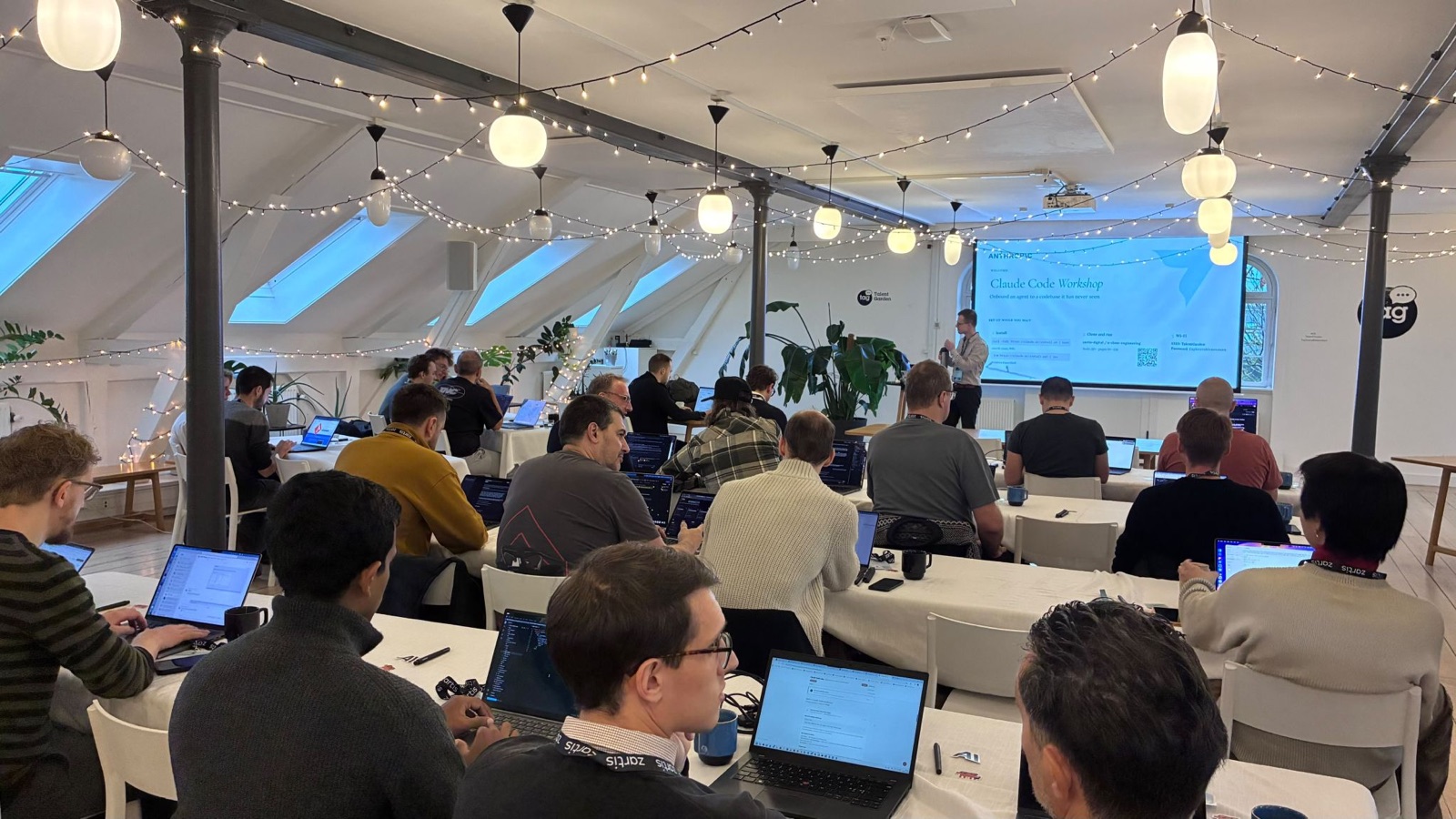
For the second time, Giannis Kokkinis travelled to Copenhagen for the Claude Code Workshop run by Zartis on 18 November at Talent Garden in the Danish capital. Among software engineers and AI specialists from across Europe, he exchanged valuable know-how on the tools that are already changing how businesses and organisations work around the world, held discussions with the Zartis team and built connections with people at the forefront of this change. Because learning never stops, and anyone who wants to stay ahead has to be where ideas meet.
Zartis is a technology consultancy specialising in AI-driven transformation and an official Preferred Services Partner of Anthropic, the company that develops Claude, one of the most advanced AI models in the world. Together with Anthropic, it runs workshops in cities across Europe and North America, and more than 150 of its engineers are certified on Claude. The Copenhagen workshop was led by Michał Szymczak, Head of AI Strategy, and Miguel de Paco Serrano, Principal Software Engineer.
The first visit was a few weeks earlier, on 19 October, at Pax8 Beyond EMEA 2026, the European conference of Pax8, the international cloud platform through which IT providers serve small and medium-sized businesses. It was there that Pax8 unveiled 8os, a platform for managing AI "agents" across businesses, and 8bot, an AI co-worker for employees of small businesses (SiliconANGLE). Three weeks later, Giannis Kokkinis released 8bot for VS Code as open source, an independent extension that brings 8bot into VS Code, one of the most widely used software development tools in the world.
The two visits fit together. The first showed how AI is reaching the small business, the second how to work with it in practice. Both matter directly to an island like Zakynthos, which lives from thousands of small businesses.
A workshop, not another conference
Participants did not just sit through presentations. They worked, each on their own laptop. The goal of the day was ambitious: an AI system had to get to grips with a codebase it had never seen and, by lunchtime, be doing useful work. Along the way, the workshop covered:
- how to give Claude all the context it needs to understand a project
- how to connect it to the tools a team already uses
- how to plan changes before any code is touched
- how to build specialised digital assistants that implement new features and review each other's work.
The organisers' conclusion captures a shift that is already under way: the engineer's role is moving from writing code to designing, delegating and reviewing. The team's know-how is written down and stays inside the project itself, while quality checks run automatically.
More work, for less money
Every year, public bodies on the island spend thousands of euros of public money on travel, stands and delegations at trade fairs, with results that are rarely measured. Giannis Kokkinis paid his own way, choosing to invest in knowledge: to be where the future is being shaped, to exchange ideas with the people building it, and to bring that experience back to Zakynthos.
Because innovation and great ideas are not born in the flashy stands of trade fairs. They are born in humble co-working spaces like Talent Garden Copenhagen, where hundreds of engineers work side by side, experiment, make mistakes and learn from one another.
And this knowledge is already producing results that anyone can see. With the same tools, the following have already been built for the Citizens of Zakynthos:
- Diavgeia search: full-text search inside every decision of the Municipality of Zakynthos on Greece's public-decisions portal, so anyone can find in seconds who was paid, how much and why.
- Public works tracker: over a hundred projects on the island, each with its contracts and payments from the national public procurement register, and who promised it and when.
- A study of 3,062 visitor reviews on the quality of tourism services, with eleven concrete proposals.
- A study on in-house waste collection, estimating savings of €540,201 a year and 64 jobs.
- A map of the foreshore with the officially demarcated stretches of coastline.
- Seven dossiers, from water and the DEYAZ water utility to the Municipal Stadium, with timelines and every primary document.
Giannis Kokkinis uses the same tools well beyond local affairs. compute.upg.gr is an open research tool for theoretical physics. Using machine learning, it ranks candidate Calabi–Yau geometries, the shapes of the "hidden" dimensions in string theory, so that researchers can find more quickly the rare cases worth studying in depth. Every result is reproducible and exports directly to the tools the scientific community uses, such as CYTools, Sage and Mathematica. With the right tools, one person from Zakynthos can now help science move forward.
All of this without a single euro of public money. Work that would take an entire department is being done by a group of citizens.
And what did residents get for the money spent?
Meanwhile, the island's public bodies pay or commit significant sums for digital platforms, websites and promotion. A few examples, all from public documents:
- The Municipality's "Digital transformation actions": €885,161.29 plus VAT. The tender was approved in October 2024 (ref. 986ΜΩΡ1-ΡΥΦ), with an 18-month delivery schedule. Among other things, it promised a smart parking system, a digital city guide, an early-warning system for floods, fires and earthquakes, online consultation on the municipal budget, public performance indicators for the Municipality, and even AI "digital assistants" to consult residents. The study for the tender alone has been paid €12,276. Two years on, which of these has any resident actually seen?
- The Open Mall "smart city" platform: €55,800. Paid for under the town-centre Open Mall project and available at zakynthos.smartiscity.gr. See for yourself. In the same project, the centre's free WiFi (€73,531) was paid off in February 2025, while the business platform never got started. Details: article 313.
- Tourism promotion on social media ("Discover Zakynthos"): €24,800. In 2025 the Municipality hired Marketing Greece to create and run Facebook and Instagram accounts promoting the island, plus €12,400 for branding services. In August 2026, a year after the contract, the official @discover.zakynthos Instagram account had 764 followers. Details: article 301 (in Greek).
- The "Explore Ionian Islands" app: €235,041. The Regional Union of Municipalities of the Ionian Islands (PED-IN), chaired by the Mayor of Zakynthos, built a tour-guide app for the Ionian Islands with EU structural funds (project "CULTURALION", 2019–2023, MIS 5030303), complete with an AI "assistant" that, as anyone who tries it can see, does not help. On Google Play it has just over 500 downloads. Yet PED-IN keeps paying: maintenance to MOBICS S.A. (€3,100 for the first 2026 instalment), promotional stickers, cards and banners (€1,674, €1,364) and travel for its associates to present it, including to Zakynthos.
- DEYAZ: €2.64 million for telemetry and leak detection. The water utility is carrying out an EU-funded project (MIS 6003175) to "install telemetry, automation and an electronic system for detecting and controlling leaks", with a budget of €2,637,561.16 (ref. ΡΕΗΕΟΡ8Ζ-ΞΝ7). How much water is lost in the network today? The figure is not published anywhere. The new DEYAZ website (€2,799.99 in 2025, plus €744 a year for hosting and support) posts the water analyses, but it was the Citizens of Zakynthos who processed them and showed that 43% of the relevant samples in town exceed the limits ("Water & DEYAZ" dossier, in Greek).
- A platform for staff leave requests: €24,552. In June 2026 the Municipality bought a digital platform for employees to submit their leave requests, a job a modern tool can do in an afternoon.
On one side, hundreds of thousands of euros on tenders, platforms and contracts that residents rarely see working. On the other, a group of citizens who, with their own means, have delivered tools that anyone who wants to know what is happening on their island uses every day.
Zakynthos risks being caught unprepared
Artificial intelligence is no longer a thing of the future. It is already here, and it is changing the job market faster than any previous technology. On an island that lives from tourism, the changes will touch almost every job: bookings and customer service, translation, marketing, accounting, property management. The same goes for public administration, from processing documents and requests to auditing spending.
Those who learn to use these tools will finish in a few hours work that takes days today. Those who fall behind will have to compete with those who moved ahead.
And yet, on Zakynthos, public bodies have done essentially nothing so far. There is not a single practical programme for tourism professionals, for staff at the Municipality and the Region, or for young people about to enter the job market. Everything we have heard amounts to vague announcements and conferences with no practical outcome.
The country has already seen results
Where the state has believed in technology and data, results have followed, and they show up in the economy:
- Tax evasion: through digitalisation and data analysis, the Independent Authority for Public Revenue (AADE) cut the VAT gap from 29% in 2017 to 11.4% in 2023, the largest reduction in the whole European Union. According to the European Commission, lost VAT revenue came down to about €3 billion in 2023.
- Public services: the gov.gr digital assistant (mAigov) has answered more than 4.4 million queries. The next step, according to the National Documentation Centre, is for it to gather the certificates a citizen needs by itself, with their consent.
- Civil servants: nearly 36,000 have already been trained in AI, and on 13 November 2026 the Prime Minister set the goal that every civil servant should use basic AI tools within four years.
- Schools: under the government's agreement with OpenAI (September 2025), AI education tools are being piloted in secondary schools.
The direction is clear at national level. On Zakynthos, local government has not taken even the first step.
A municipality that runs on AI
This is not science fiction. With tools that exist today and cost very little, the Municipality of Zakynthos could work very differently:
- Round-the-clock service, in every language: information, applications and case tracking, for residents and for the island's hundreds of thousands of visitors.
- Incoming mail: every incoming document is classified and routed automatically to the right department, with a deadline and a reminder, so that no request gets lost in a drawer.
- Reporting problems: a phone photo of a pothole, an overflowing bin or a broken streetlight is placed on the map, prioritised and assigned to a crew.
- Finance: every expense checked before it is paid, prices compared with other municipalities, split contracts and repeated direct awards flagged.
- Technical services: tender documents and studies drafted in days instead of months, every contract and every deadline tracked.
- Waste collection: collection routes planned on real data: how full the bins are and each week's tourist traffic.
- DEYAZ: leaks detected from network measurements and continuous analysis of water quality.
- Municipal Council: transcripts and minutes the same day, searchable by every resident.
- Transparency: what the Citizens of Zakynthos do today with Diavgeia and public works, done by the Municipality itself, for everyone.
And this is not theory. ChronoTicket, a request-management platform developed by Giannis Kokkinis, already does exactly this for businesses: every request, whether it arrives by email or through a form, becomes a "case" with an owner, a deadline and a full history, the time spent on it is logged, and AI agents can connect to sort and route requests. The same model could be applied tomorrow to the Municipality's incoming mail and residents' requests.
Employees are not replaced. Their role changes. They describe, delegate and review, exactly like the engineer at the Copenhagen workshop. The machine does the time-consuming work, and people decide and sign. And none of this needs tenders worth hundreds of thousands of euros. It needs people who know how to use the tools.
Design, delegate, review: that is how a mayor should work too
The engineer's role is moving from writing code to designing, delegating and reviewing.
The lesson from Copenhagen is not just for engineers. It is a model of management. The engineer stops writing every line by hand: he describes clearly what is needed, delegates the work and reviews the result. That is exactly how the leadership of a municipality should work.
The mayor designs. He does not get lost in the day's paperwork, phone calls and signatures. He sets measurable targets: how many days the Municipality takes to answer a request, how many tonnes go to recycling, how much water is lost in the network, when each project is delivered.
Deputy mayors delegate. Each, in their own area, hands out work to departments, crews and digital tools, with a clear description, a deadline and a person responsible. And each department's know-how is written down, like the know-how that stays inside the codebase, so it is not lost every time an employee retires or moves on.
Everyone reviews with data. Not with last-minute reports, but with a real-time picture of every request, every expense, every contract. And as with code, quality control is automatic: nothing is paid for and nothing is signed off without being checked.
A mayor who handles every small matter personally is like an engineer who writes every line of code by hand: he works hard and achieves little.
The same goes for hoteliers and business owners
The same model can transform every business on the island.
- The hotelier designs the guest experience and the pricing policy, and delegates to AI tools the replies to messages and bookings in every language, review analysis, occupancy forecasts, and scheduling of shifts and supplies. The hotelier checks the quality and the results.
- The restaurant owner orders based on forecast demand and cuts waste, updates menus and communication in many languages, and prepares the accounts and the marketing in minutes.
- The small shop, the rental office, the travel agent gain capabilities that until yesterday only large companies with whole departments of staff had.
On an island with strong seasonality and a constant shortage of staff, this is not a luxury, it is survival. The business owner who learns to design, delegate and review will do more and better work with the same team. Whoever waits will end up competing against them.
The island's politics stops at ChatGPT
When the island's political leadership talks about artificial intelligence, the horizon usually ends at a chat window: a question to ChatGPT, a draft press release, an image for social media.
Meanwhile, the rest of the world has moved on to the next stage. AI systems no longer just answer questions. They read thousands of documents, check contracts, write and test software, and carry out entire processes from start to finish, with people designing and reviewing. That was exactly the subject of the Copenhagen workshop.
The difference between the two is the difference between a pocket calculator and an entire accounts department. And as long as our elected officials stay with the calculator, Zakynthos falls behind.
Our proposals: practical, from tomorrow, at almost no cost
There is no need to wait for training programmes and funding that take years to arrive. The Municipality already has everything it needs to start.
- Weekly workshops at the Cultural Centre (Pnevmatiko Kentro). One evening a week, in a hall that already exists, at almost zero cost. Everyone brings their own laptop and learns, hands-on, to use the tools in their own work, just as at the Copenhagen workshop.
- Evenings for each audience: one for hoteliers and property owners, one for restaurants and shops, one for staff of the Municipality, DEYAZ and the Region, one for students and young people. With examples from their own daily work, not generic presentations.
- A pilot in one department, in 30 days. For example, residents' requests or incoming mail, with a measurable target: how many days the Municipality takes to answer today, and how many afterwards.
- A check before every new digital purchase: is there already a tool that does the same job for a fraction of the cost? If so, the money goes elsewhere.
- Less on trade-fair stands, more on knowledge that stays on the island.
The Citizens of Zakynthos are open to briefing the Municipality, business and hoteliers' associations, and any organisation that wishes, on how artificial intelligence can help in their work, with concrete examples from their own daily operations. We can coordinate the effort, or even bring a similar workshop to Zakynthos, drawing on our good relations with the companies that run them. All it takes is the decision to begin.
Sources on AI in the Greek public sector: AADE, VAT gap (12/12/2025) · European Commission, tax gaps report (11/12/2025) · mAigov, 4.4 million queries · National Documentation Centre on the gov.gr assistant (15/11/2026) · AI training for 36,000 civil servants · Prime Minister, 13/11/2026 · Agreement with OpenAI (5/9/2025).