The illusion of knowledge in local government
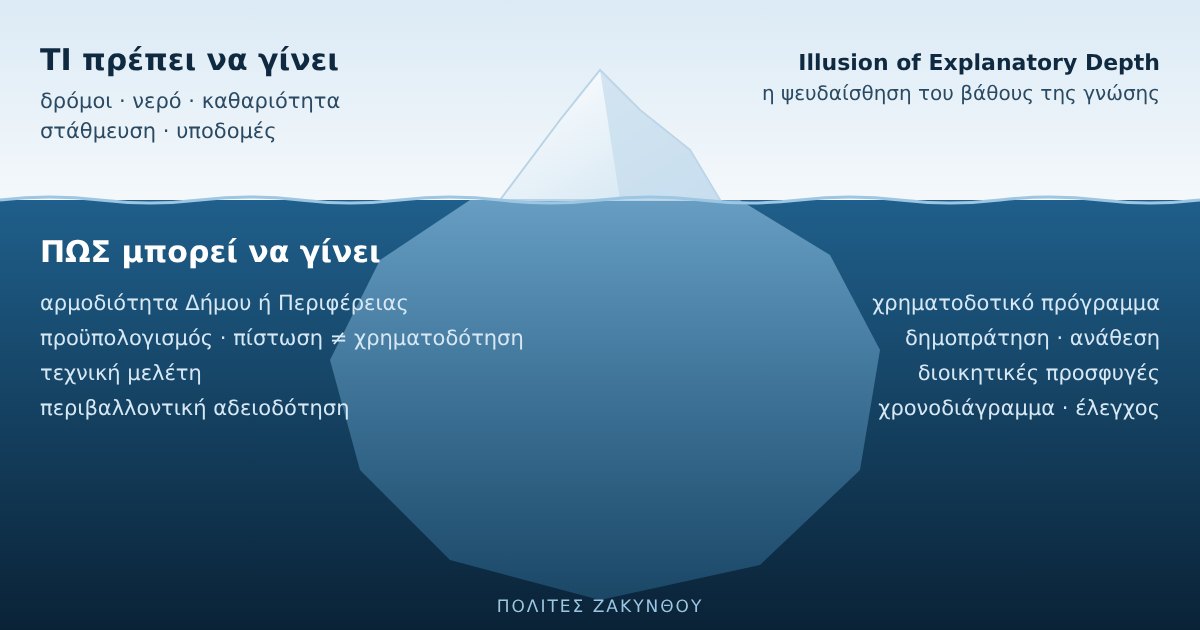
We all know what needs to be done. But are we just as sure that we know how it can be done?
There is an interesting psychological phenomenon called the Illusion of Explanatory Depth.
It describes people's tendency to believe they understand in depth how things work, until the moment they are asked to explain them in detail, step by step. That is when they often discover that their real knowledge is far more limited than they thought.
If we carry this phenomenon over to local government, we will recognise something very familiar.
The "what" and the "how"
In our daily lives, all of us have an opinion about what needs to be done in our town.
Fix the roads. Solve the water problem. Deal with cleanliness. Create parking spaces. Improve infrastructure. Make use of municipal property.
And of course, citizens have every right to demand solutions. Criticism needs no permission, and calling for a better everyday life requires no special knowledge.
But there is an important difference between knowing what we want and understanding how it can be achieved.
The questions below the surface
How many people really know which responsibilities belong to the Municipality and which to the Region? How a municipal budget is drawn up and executed? What the difference is between a budgeted appropriation and funding that is actually available? How a public project moves from the initial idea to tendering, award and completion?
How many know what environmental permitting, a technical study, a funding programme, a tender procedure or an administrative appeal actually involve?
Even more, how many can explain why a project that looks simple to the citizen may in practice require years of procedures?
Not an excuse, but better criticism
These questions are not asked to justify delays, inaction or failures. Nor to grant municipal authorities immunity from criticism.
On the contrary, they are asked so that our criticism becomes more substantive and our demands more specific.
Because local government is not simply the art of recognising problems. It is the ability to turn them into workable solutions, within a specific institutional, financial and technical framework.
And this concerns everyone: elected officials, those involved in public life, political groups, and citizens themselves.
It is not enough to say that something must be done. We need to be able to discuss who is responsible, what is required, how much it costs, where the funding will come from, on what timetable it can be delivered, and how the result will be checked.
From slogans to evidence
Perhaps, then, what Zakynthos really needs is not for all of us to have more opinions, but for all of us to have a deeper understanding.
To move from easy certainty to knowledge. From slogans to evidence. From demands without a plan to advocacy with concrete proposals.
Because democracy does not need less criticism. It needs better-informed citizens, more transparency, and elected officials who can explain not only what they promise, but also how they intend to achieve it.
Zakynthos does not need people who merely believe they know. It needs people who are willing to learn, to back up their claims with evidence, and to take responsibility for their proposals.
Citizens of Zakynthos
Translated from the original Greek article.