Zakynthos olive oil: €2.70 to the farmer, €6–10 on the shelf. Where does the difference go?
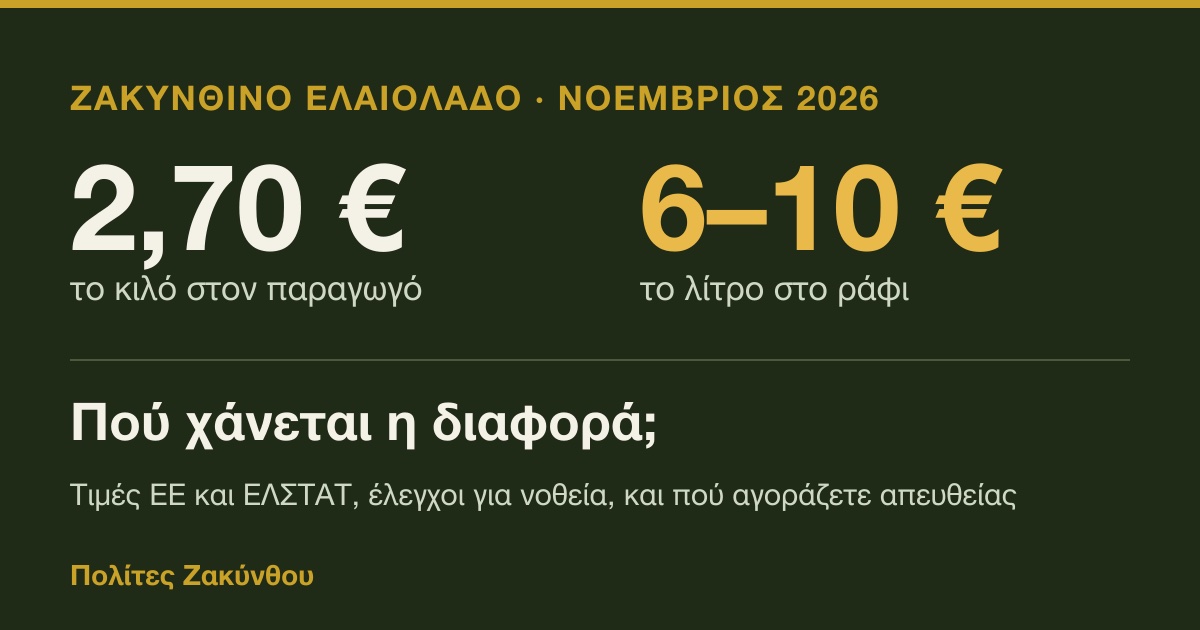
All through November we have read that Zakynthos olive oil is selling for €2.70 to €3. No one in Zakynthos who does not own olive trees can buy it at that price. In the supermarket, extra virgin olive oil costs from €6.19 a litre upwards. We researched where exactly the problem lies, using official data rather than impressions.
First, a clarification: the €2.70 is per kilo, and it is the price paid to the producer. A litre of olive oil weighs about 916 grams, so €2.70 per kilo is about €2.47 per litre.
1. What the Zakynthos producer gets
- €2.70/kg. Dinos Betsis, president of the Zakynthos Olive Mills Association, on 16 October: the price "is currently around €2.70 in Zakynthos". If quality is poor, "it could go down to €1.50". Nikos Soulis, former president of the olive millers' association, gave the same price on ERT3 (18 November).
- €3.20–3.50/kg for new-season oil, with "some cases even lower" (Imera, 14 November).
- €4–5/kg is what the mills need to stay viable (Betsis). About €5/kg is what a producer needs to earn a living, according to the director of the Union of Agricultural Cooperatives of Zakynthos.
Out of this, the producer also pays the "xai", the share of the oil the mill keeps as payment. This season it rose from 10–11% to 13–15%, because electricity, fuel and the transport of olive pits went up: Zakynthos has no pomace-oil plant, so all the pits are shipped to the Peloponnese. With a 15% share and a price of €2.70, every 100 kilos of oil a producer makes leaves them 85 kilos, or €229.50. From that they pay for picking, fertiliser, fuel and spraying.
The result shows in the groves. According to the mills themselves, some producers are not harvesting this year, because picking costs more than the oil fetches. Owners are selling olive groves and vineyards, and villas are now being built on many of these plots.
2. What the official data show
The European Commission publishes producer prices every week, by country and market. In the week of 9–15 November 2026 the Greek average was:
| Category | € / kg | ≈ € / litre |
|---|---|---|
| Extra virgin (Greece) | 3.26 | 2.98 |
| Virgin (Greece) | 2.80 | 2.56 |
| Lampante, not edible without refining (Greece) | 1.90 | 1.74 |
The Zakynthos price of €2.70 is below the Greek average for extra virgin, almost at the level of virgin oil.
Prices from 2018 to today
Annual average producer price for extra virgin olive oil, € per kilo:
| Year | Greece | Spain | Italy |
|---|---|---|---|
| 2018 | 2.95 | 2.97 | 4.59 |
| 2019 | 2.62 | 2.36 | 4.79 |
| 2020 | 2.25 | 2.15 | 3.66 |
| 2021 | 3.03 | 3.08 | 4.46 |
| 2022 | 3.60 | 3.81 | 4.65 |
| 2023 | 6.32 | 6.70 | 7.51 |
| 2024 | 7.37 | 7.53 | 9.31 |
| 2025 | 4.19 | 4.04 | 9.14 |
| 2026 (Jan–Nov) | 3.97 | 3.88 | 5.80 |
The peak was in January 2024, at €8.82/kg. Since then the price has halved and fallen below last year's: in October 2026 it was €3.54, against €4.39 in October 2025 (−19.4%). In November it fell further, to €3.31.
Why prices fell
The Greek price follows the Spanish one: in the table the two are almost identical every year. Spain produces 60% of the EU's olive oil and Greece 14%. For 2025/26 the Commission forecasts Greek production down 20%, Tunisian production up 32%, and EU imports from non-EU countries at 267,000 tonnes, against 180,000 the year before. Dionysis Vertzagias, president of the Union of Agricultural Cooperatives of Zakynthos, said it in September: the price "has fallen a great deal because of imports of olive oil from third countries".
So a smaller Greek harvest and still a low price. The price a Zakynthos producer gets does not depend on how much oil Zakynthos produces, but on how much oil there is in Spain and North Africa.
3. What the consumer pays
Shelf prices at the My Market online shop on 28 November 2026, for extra virgin olive oil:
| Product | Price (€) | € / litre |
|---|---|---|
| Ionis Extra Virgin 1 l | 6.19 | 6.19 |
| My Kouzina Extra Virgin 4 l | 24.90 | 6.22 |
| Xenia Extra Virgin 4 l | 25.80 | 6.45 |
| Terra Creta Chania 4 l | 27.56 | 6.89 |
| Epos Extra Virgin 1 l | 6.95 | 6.95 |
| Latzimas Extra Virgin 4 l | 28.90 | 7.22 |
| Xenia Extra Virgin 1 l | 7.70 | 7.70 |
| Minerva Chorio Koroneiki 1 l | 8.48 | 8.48 |
| Altis Extra Virgin 3 l | 26.70 | 8.90 |
On Skroutz the same day, 35 extra virgin olive oils in 5-litre tins had a price. The cheapest was €6.00 a litre and the median €9.88. However cheaply you find it, extra virgin on the shelf costs more than twice what the Greek producer is paid, and about 2.5 times what the Zakynthos producer is paid.
ELSTAT, the Greek statistics authority, shows that the drop does not pass to the shelf in full either. In October 2026 the retail price of olive oil was 8.4% lower than in October 2025. The producer price fell 19.4% over the same period.
The difference covers packing, the bottle, transport, the margins of the trader and the supermarket, and VAT. How much each of them takes is not published anywhere. ELGO-DIMITRA, in an answer to Parliament in November, acknowledges a "lack of reliable data" and the "low bargaining power of producers". The Zakynthos branch of ELAS is calling for a National Observatory of Prices and Production Costs that would record prices from the producer to the shelf.
4. Fraud and inspections
When market prices fall, the bottled "extra virgin" on the shelf is not always what the label says.
- Imathia, February 2026. Police broke up a ring that bought sunflower oil, added colourings and flavourings, and bottled it as "Extra Virgin Olive Oil", with the names of well-known Greek producing regions and fake awards. Over six years it sold 600 tonnes in Greece. Consumer losses are estimated at €3.4 million.
- EFET inspections 2023–2025. Of 144 samples of extra virgin olive oil, 16 were non-compliant, and 3 of those were adulterated with other oils. In 36 special authenticity checks, 8 businesses had non-compliances "relating to possible fraudulent or misleading practices" (EFET's answer to Parliament, November 2026).
- European Court of Auditors, Special Report 01/2026:
- Greek marketing checks cover only oil produced in Greece for the Greek market. Imported oil and oil for export are left out.
- At retail level, checks do not verify whether the country of origin on the label is true.
- Greek fines do not take into account the profit from selling cheaper oil as extra virgin, and a decision on the penalty takes 14 months on average. In Italy it takes 36 days.
- In Greece, oil from two harvests may be blended and labelled with the date of the newer one.
5. For consumers: what to look for
- The category. Only four categories may be sold at retail: Extra virgin olive oil (acidity up to 0.8%), Virgin olive oil (up to 2%), Olive oil composed of refined olive oils and virgin olive oils, and Olive-pomace oil. Words such as "Classic" or "Traditional" are not a category. Read what is written underneath.
- The EL code. Every unit that packs olive oil needs approval from the regional agricultural directorate (DAOK) and a number of the form EL-40-xxx. That number is printed on the label. If it is missing, the product has not been legally packed.
- The container. Olive oil may only be sold to consumers pre-packed, in containers of up to 5 litres, with a closure that breaks on first opening. Larger containers are allowed only for restaurants, hospitals and canteens (EFET, Olive oil marketing and labelling rules, 2026). A 17-kilo tin with no label and no receipt, "from a friend of a friend", does not protect you if the oil is not what you were told.
- The price. With the Greek producer at €3 a litre, an "extra virgin" at €4 a litre on the shelf does not add up. Something is wrong.
- The receipt. Always. Without it you cannot file a complaint.
Complaints about olive oil go to EFET (efet.gr), the Hellenic Food Authority, and to the DAOK of Zakynthos.
6. For the Zakynthos producer
- Ask for an acidity analysis at the mill. The category sets the price: €3.26 for extra virgin, €2.80 for virgin and €1.90 for lampante, in the same week. Without a lab report you are negotiating blind.
- File your harvest declaration and check that the mill's receipt shows, as it should, your full name and tax number, the variety and the grove code.
- Sell together. ELGO-DIMITRA lists "limited collective organisation" as a key weakness. A small producer with 300 kilos cannot negotiate. A cooperative with 300 tonnes can.
- Pack through an approved unit. With an EL code and a label, Zakynthos oil can be sold to consumers on the island, to visitors, to restaurants and to hotels, at a price per litre several times the €2.70 of bulk oil.
7. Buy direct: the approved olive oil packing units of Zakynthos
The best way to keep the money on the island is to buy packed Zakynthos olive oil directly from those who produce and bottle it legally. The list below is the official list of the Greek Ministry of Rural Development and Food of approved olive oil packing units (edition of 23 October 2026), for the Regional Unit of Zakynthos. Phone numbers are from the Greek Yellow Pages (xo.gr).
| Business name | Approval code | Phone |
|---|---|---|
| Soulis Chaikalis & Co. Ltd (Aristaion) | EL-40-171 | +30 26950 52888 |
| Eleftherios I. Vourtsis | EL-40-183 | |
| P. & S. Tzavala – N. Chrysou OE | EL-40-191 | |
| E.A.S. Zakynthou (Agricultural Cooperative) | EL-40-208 | |
| P. & K. Solomos & Co. EE ("Solomos Olive Oil") | EL-40-241 | |
| Elaiourgiki N. & E. Vlassopoulos OE | EL-40-283 | |
| Lamprinos Margaris & Co. OE | EL-40-464 | +30 26950 48848 |
| Theodosis Nik. & Co. EE | EL-40-616 | |
| Tourkakis F. Nikolaos | EL-40-618 | +30 26950 62407 |
| Rizes S.A. | EL-40-666 | |
| Ioannis Anast. Solomos | EL-40-724 | |
| Pylarinou Panagiota | EL-40-804 | |
| Betsis Bros OE | EL-40-869 | +30 26950 61178 |
| A. Patrinos & Son OE | EL-40-942 |
Source: Greek Ministry of Rural Development and Food, Approved Olive Oil Packing Units (xlsx file).
Before you buy, ask about the harvest, the category and the acidity analysis. A serious producer will show you.
Are you a Zakynthos producer, mill or cooperative with approved packing, missing from the list, or would you like your phone number added? Write to us at [email protected] or through the Contact page, with the EL code of your unit, and we will update the list.
What we are asking for
- From the Region and the DAOK of Zakynthos: a public list of the island's olive mills and packing units, with contact details.
- From the Ministry: publication of the names of products found adulterated or in the wrong category, as is already done for other foods.
- From the government: an observatory of prices from the producer to the shelf, with public data on where the difference goes.
- From the Municipality: packed Zakynthos olive oil in schools, events and municipal facilities, and an annual olive oil producers' market.
Frequently asked questions
How much are olive oil producers in Zakynthos paid in November 2026?
About €2.70 per kilo (≈€2.47 per litre) according to the Zakynthos olive mills association, and €3.20–3.50 per kilo for new-season oil according to the newspaper Imera (14 Nov 2026). The average Greek producer price for extra virgin was €3.26/kg in the week of 9–15 Nov 2026 (European Commission).
How much does extra virgin olive oil cost on the shelf in Greece?
On 28 Nov 2026, €6.19–8.90 per litre at the My Market supermarket. On Skroutz, 35 extra virgin oils in 5-litre tins cost €6.00–19.90 per litre, median €9.88.
Why did olive oil producer prices fall?
Greek prices follow Spanish prices. For 2025/26 the European Commission forecasts Tunisian production up 32% and EU imports at 267,000 tonnes against 180,000. In October 2026 the Greek producer price was 19.4% lower than in October 2025.
Why do shelf prices not fall as much as producer prices?
According to ELSTAT, retail olive oil prices in October 2026 were only 8.4% lower than a year earlier, while producer prices fell 19.4%. How the difference splits between bottling, transport, trade and VAT is not published.
How can I tell if olive oil is really extra virgin?
The label must say 'Extra virgin olive oil' (acidity up to 0.8%) and carry the code of an approved packing unit (EL-40-xxx). Olive oil may only be sold to consumers pre-packed, in sealed containers of up to 5 litres. Words like 'Classic' are not a category. Always keep the receipt.
Where can I buy Zakynthos olive oil directly?
From the 14 approved olive oil packing units in Zakynthos on the official list of the Greek Ministry of Rural Development and Food (23 Oct 2026), listed in the article with their EL codes.
What is the mill's share ('xai')?
The share of the oil a mill keeps as payment. In Zakynthos it rose this season from 10–11% to 13–15%.
Sources
- European Commission, Olive oil: market prices (weekly prices, xlsx) and DG AGRI dashboard (updated 30 Sep 2026)
- ELSTAT, Consumer Price Index, October 2026 (10 Nov 2026)
- European Court of Auditors, Special Report 01/2026: Olive oil control systems in the EU
- EFET, Olive oil marketing and labelling rules (2026, in Greek)
- Greek Ministry of Rural Development and Food, Approved Olive Oil Packing Units
- Answers of the Ministry, ELGO-DIMITRA and EFET to a parliamentary question by MP E. Vatsina, cretaone.gr, 28 Nov 2026
- Imera (Zakynthos): 29 Sep · 16 Oct · 19 Oct · 13 Nov · 14 Nov
- Zante Times, Olive oil below €3 (18 Nov 2026)
- Cibum, Olive oil adulteration ring broken up in Imathia (22 Feb 2026)
- Retail prices: mymarket.gr · skroutz.gr, olive oil 5 l (28 Nov 2026)
Original article in Greek: Ζακυνθινό λάδι: 2,70 € στον παραγωγό, 6–10 € στο ράφι. Πού χάνεται η διαφορά; · Machine-readable version